County Wexford Ireland · Co. Wexford · Ballindaggin Save · Share
POSTED FROM
BALLINDAGGIN
CO. WEXFORD · IE

Ballindaggin
Baile an Daingin, Co. Wexford

The Ireland's Ancient East
STOP 06 / 06
Baile an Daingin · Co. Wexford

A parish in the Blackstairs foothills with a church, a school, and a mountain at the back.

Ballindaggin is a small rural parish in north-west Wexford, in the foothills of the Blackstairs Mountains, about twelve kilometres from both Enniscorthy and Bunclody. The Irish name, Baile an Daingin, means townland of the stronghold - there was some kind of fortified site here once, though no above-ground remains survive. The parish today is a scatter of farmhouses, a church, a school, and a GAA pitch, all set against Mount Leinster on the western horizon.

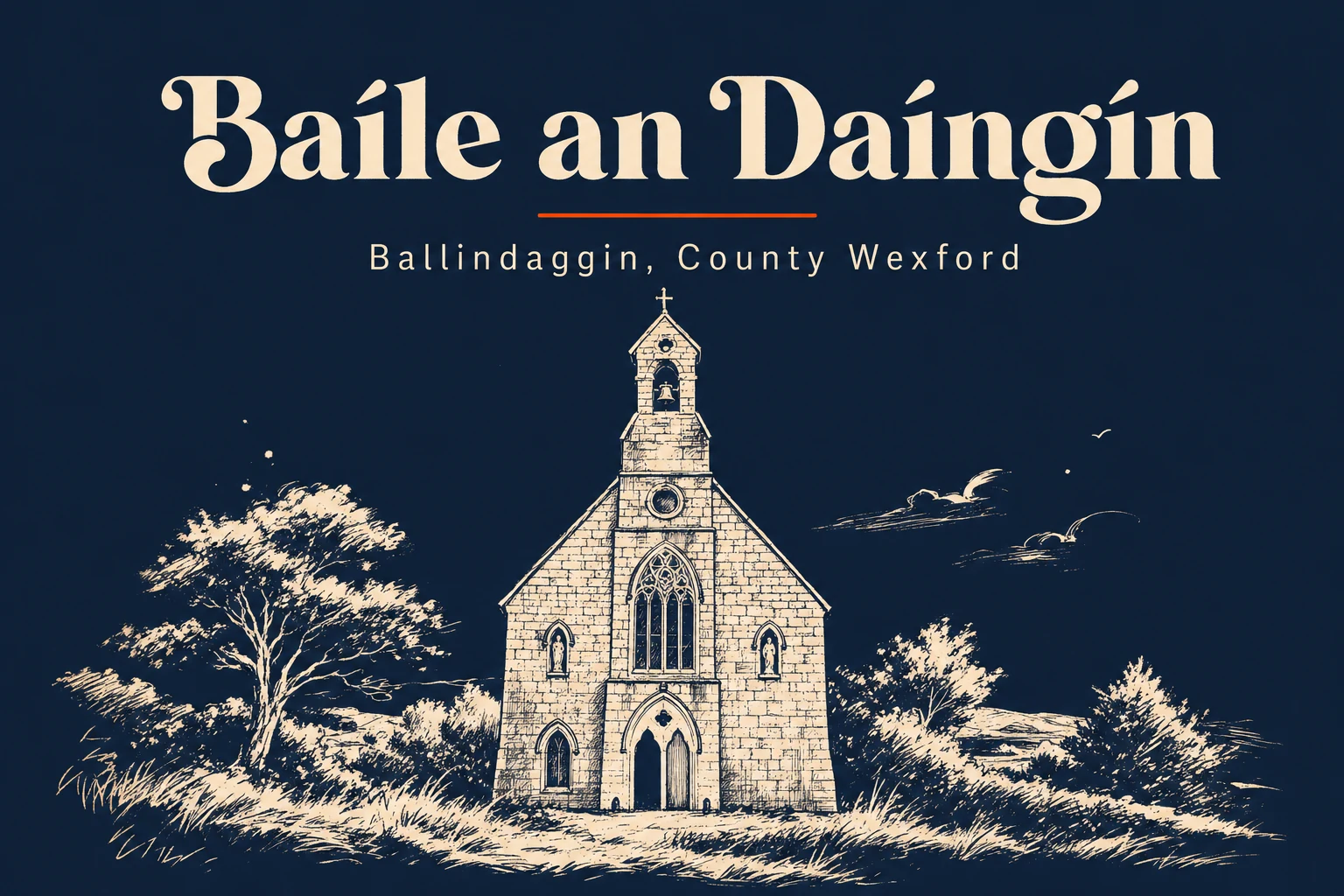
The history runs the way it does in this corner of Wexford: ancient Gaelic territory, a Catholic parish revived in the 19th century, a 1798 rebellion that passed through and left its dates on the calendar. St Colman's Catholic Church was built in 1864 and is still the centre of the parish. Duffry Rovers GAA play out at Coolree. The mountain is the reason most outsiders come - drive up the back road as far as the public tar goes, then walk the last stretch to the transmitter on the summit. On a clear day you can see five counties. On the days that are not clear you are inside the cloud and you cannot see your boots.
01 / 06

At a glance.

Three things every local will eventually mention. Read these and you've already understood more than most day-trippers do.

02 / 06

Stories & lore.

The reason to come back. The things every local will eventually tell you about, usually after the second pint.

Mount Leinster, 794 metres

The Blackstairs at the back door

The high point of the Blackstairs sits on the Wexford-Carlow line a few kilometres west of the parish. The 2RN transmitter mast on the summit is the thing you see from half the county. The Nine Stones road climbs the back of the mountain from the Wexford side and ends at a car park near the top; the last stretch to the mast is on foot. On a clear day the view runs to Wicklow, Kilkenny, Tipperary and the sea at Wexford. On most days the mountain wears its own weather and you wait for a break.

The rebellion at the parish door

1798 in west Wexford

The 1798 rebellion ran through this corner of Wexford in late May and June. The Battle of Bunclody was fought twelve kilometres north on 1 June; the Battle of New Ross south of here on 5 June; Vinegar Hill at Enniscorthy on 21 June. Ballindaggin sits inside that triangle. The parish would have lost men to all three engagements, though no battle was fought in the village itself. The 1798 commemorations in the surrounding towns each June are the local memory of it.

The 1864 church and the parish around it

St Colman's parish

St Colman's Catholic Church was built in 1864 and consecrated in the era of post-Emancipation church-building that produced most of the Catholic churches in rural Wexford. It is a five-bay Gothic Revival building in local stone, still the working parish church. The national school of the same name sits nearby; Duffry Rovers GAA play out at Coolree. There is also a smaller Church of Ireland church at Templeshanbo, older than the Catholic one, that serves the same wider district from the other denomination.

03 / 06

Things to do outside.

Wear waterproofs. Bring a sandwich. Tell someone where you're going if it's the mountain.

Mount Leinster from the Nine Stones Drive up the Nine Stones road on the Wexford side of the mountain - the public tar runs most of the way to the summit. Park at the shoulder and walk the last service track to the 794-metre top. Boots, coat, and a forecast that holds; do not start in cloud.
6 km return from the car parkdistance
2.5-3 hourstime
The parish lanes The byroads around Ballindaggin, Kiltealy and Templeshanbo are good slow walking. Hedges, hay sheds, very little traffic. The mountain stays on your right or your left depending which way you have turned.
5-8 km loopsdistance
1-2 hourstime
04 / 06

When to go.

There is no bad time. There are different times.

Spring
Mar-May

Gorse on the lower slopes of the Blackstairs and lambs in the fields. The summit road dries out properly by April.

◉ Go
Summer
Jun-Aug

Long evenings on the mountain. The 1798 commemorations in the surrounding towns land in late June if that interests you.

◉ Go
Autumn
Sep-Oct

Heather and bracken turning rust-red on the ridge. The quietest months on the hills.

◉ Go
Winter
Nov-Feb

The Nine Stones road ices over and the cloud sits on the summit for days. Stay low or go properly equipped.

◐ Mind yourself
05 / 06

What to skip.

Honestly? Don't bother.

If a local was sitting beside you, this is the bit where they'd lean in.

×
Coming for "the village"

There isn't a village in the usual sense - Ballindaggin is a parish of scattered houses with a church, a school and a GAA ground at its centre. Pair it with Mount Leinster, Enniscorthy or Bunclody or you'll be back in the car in five minutes.

×
The summit road in low cloud

The whole point of going up is the view. If the top of the mountain is inside the cloud - and it often is - drive somewhere else and come back another day.

+

Getting there.

By car

About 12 km west of Enniscorthy and 12 km south of Bunclody on minor roads. Signposted off the R702 and the N80. No through-traffic - you arrive on purpose.

By bus

No direct service. Nearest Bus Éireann stops are in Enniscorthy and Bunclody; you need a car from there.

By train

Nearest station is Enniscorthy on the Dublin-Rosslare line.

By air

Dublin Airport is about 1h 45m by road. Waterford is closer but has minimal flights.