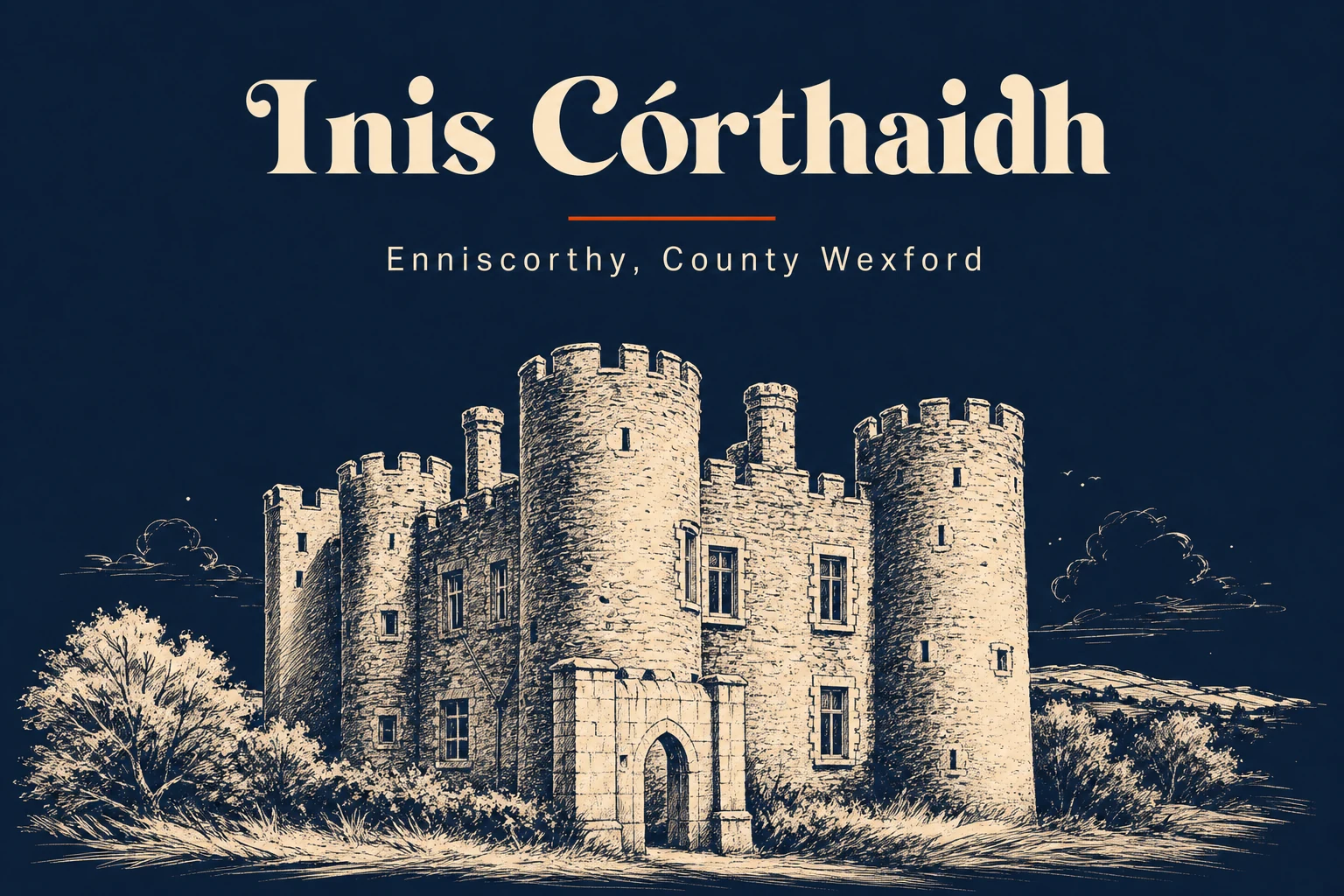
Inis Córthaidh · Co. Wexford
A town built on a hill that lost a battle and never quite let it go.
Enniscorthy sits on a steep bend of the Slaney, halfway between Dublin and the sea, with a Norman castle at the bottom of the town and a green hill to the east where a battle was lost. The river is the Slaney, not the Barrow - every guidebook gets that wrong eventually. The town climbs from the bridge in two hard minutes of slope, which is why your calves know you've been here.
The shape of the place is 1798. The United Irishmen took the town in May, made Vinegar Hill their headquarters, held most of Wexford for a month, and were broken on the hill on the morning of 21 June. The Pikemen statue in the Market Square - Father Murphy and a young rebel, by Oliver Sheppard, unveiled in 1908 - is the apology the town never quite got. The National 1798 Rebellion Centre, in a redeveloped Christian Brothers' school, is the long version. Walk up Vinegar Hill afterwards and the geography of the defeat reads itself.
The other thread is Colm Tóibín. He was born in Enniscorthy in 1955 and the town is the through-line of half his books - Brooklyn especially, where Eilis Lacey leaves these streets for New York and is half-undone by it. The streetscape he writes is still there: the cathedral up the hill, the square with the statue, the river at the bottom. Read the novel, then come and walk it. The two layers fit each other almost too well.
The cathedral itself is the third reason you came. Saint Aidan's, foundation stone laid 1843, the largest church Pugin built in Ireland, modelled by him on the ruins of Tintern Abbey. The spire went up later under another hand. The whole thing was put together around the old thatched church inside it, which they pulled down only when the new walls had closed over the top. That's the pattern of the town in one image: new walls around old bones, and the river running past underneath.