County Wexford Ireland · Co. Wexford · Duncormick Save · Share
POSTED FROM
DUNCORMICK
CO. WEXFORD · IE

Duncormick
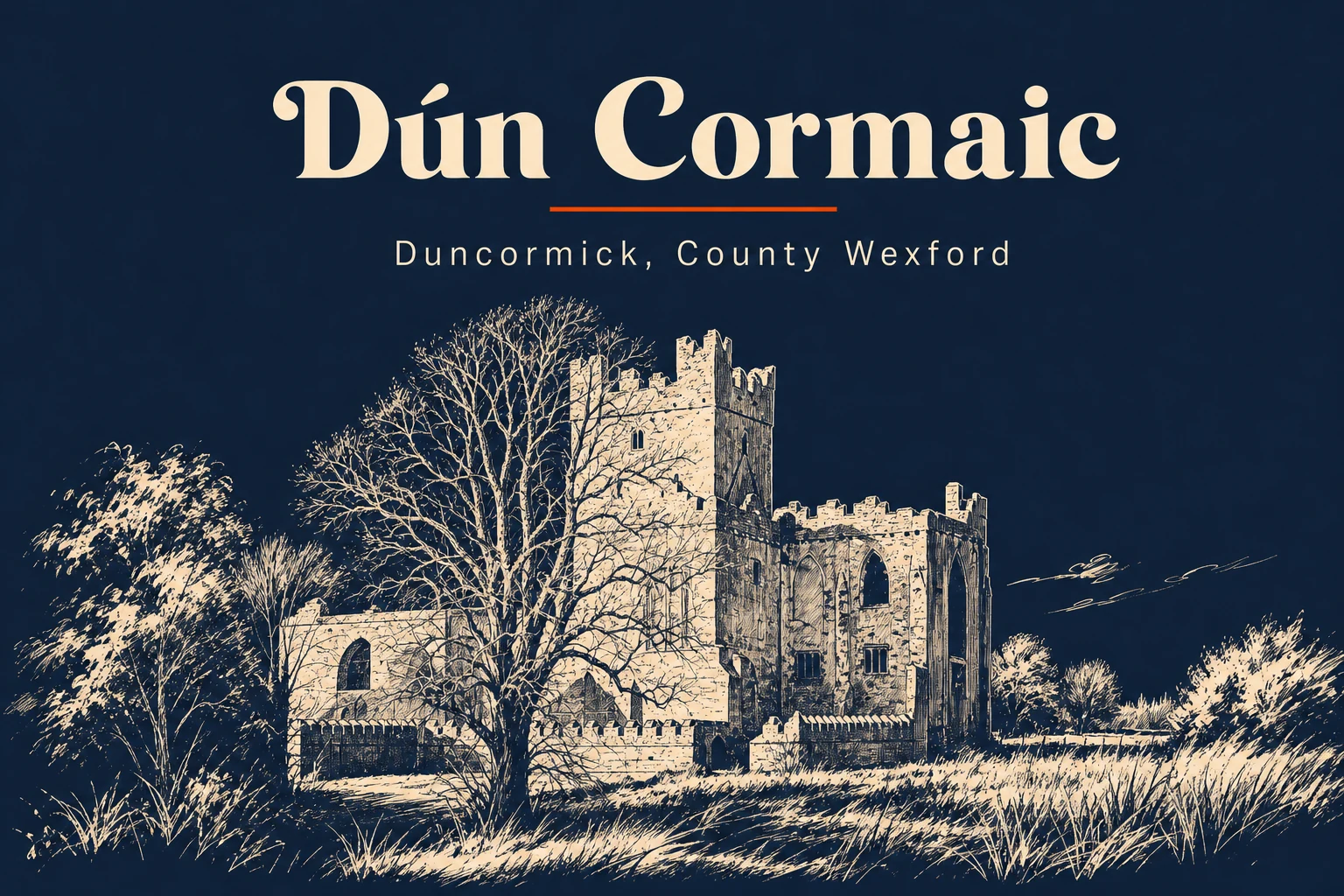
Dún Cormaic, Co. Wexford

The Ireland's Ancient East
STOP 07 / 07
Dún Cormaic · Co. Wexford

A thatched pub on the main street and a strand five minutes south. Bargy country.

Duncormick is a one-pub crossroads village in the old barony of Bargy, in the corner of south Wexford between Wexford town and Kilmore Quay. The name comes from a 6th-century fortress - Dún Cormaic, Cormac's fort - said to belong to Cormac Mac Diarmata of the Uí Bairche, who was briefly king of Leinster. The fort is long gone. What survives is the name, a thatched pub on the main street, a small Catholic church, a river bridge and a stretch of disused railway platform where the South Wexford line ran from 1906 to 1976. The village had about 250 people in the 1850s. It has about 120 now. The rest went where the rest always go.

This is Yola country. Until the mid-1800s the baronies of Forth and Bargy - the south-east tip of Wexford - spoke their own dialect, a Middle-English survival brought in by the Normans in 1169 and kept alive in pockets for six hundred years. Most of the vocabulary was Old English; the borrowings were Irish and French. By the time the railway came it had stopped being a daily language, but it left its mark on the placenames around here - Killag, Tomhaggard, Tagoat, Cullenstown - and on the way the older people still speak. Duncormick is not a Yola museum. It is just a village in the country where Yola once was, and that is the texture of the place.

The reason you actually come is the coast. Cullenstown Strand is five minutes south by car, a long flat beach looking out at the Saltee Islands and the small uninhabited Keeragh Island. Ballyteige Burrow National Nature Reserve runs west of it - nine kilometres of dune system, one of the most important coastal habitats on the south-east. You park, you walk, you come back to Sinnott's for a pint. That is Duncormick. There is not more to it, and the people who live here are not pretending there is.
Population
~120 (116 at the 2016 census)
Walk score
A pub, a church, a bridge, a closed platform. Ten minutes end to end.
Founded
Name from a 6th-century fortress of Cormac Mac Diarmata
Coords
52.2167° N, 6.6333° W
01 / 07

At a glance.

Three things every local will eventually mention. Read these and you've already understood more than most day-trippers do.

02 / 07

The pubs.

None of these are themed Irish pubs, because they don't need to be. A few that earn the trip:

Sinnott's

Local, low-ceilinged, family-run
Thatched village pub with rooms

The pub on the main street, in a thatched building reckoned at around two hundred years old. Main bar at the front, lounge and card room out the back, accommodation rooms on the first floor. Properly local - most nights it is people from the parish. Hours go shorter in winter; ring before you drive.

03 / 07

Stories & lore.

The reason to come back. The things every local will eventually tell you about, usually after the second pint.

Cormac Mac Diarmata, 6th c.

The fort that gave the name

Long before the Normans, this part of south Wexford was the territory of the Uí Bairche - the tribal grouping whose name survives in the barony of Bargy. Tradition has it that a 6th-century chief of the Uí Bairche, Cormac Mac Diarmata, was for a time recognised as king of Leinster, and that he had a coastal stronghold here. Dún Cormaic - Cormac's fort - became the placename. The fort itself is gone. The name has outlasted every other thing the man ever did.

The lost dialect of Forth and Bargy

Yola

Duncormick sits in the old barony of Bargy, one of the two south-Wexford baronies where Yola was spoken. Yola was a Middle-English dialect brought in by the Welsh, Norman and Flemish settlers after 1169 and preserved here, in a small pocket of country, for nearly seven hundred years. Most of its vocabulary was Old English; the borrowings were Irish and French. It stopped being a daily language by the mid-19th century - the Famine, the railway, mass literacy in standard English finished what they always finish. A glossary survives. A few rhymes survive. Most of what survives is in the place names you drive past on the way here.

The Boolavogue cottage

P.J. McCall's summer

Patrick Joseph McCall - Dublin publican's son, ballad-writer, antiquarian - kept a summer cottage in Duncormick. From it, in 1898, the centenary of the 1798 Rebellion, he wrote "Boolavogue" to the old air "Eochaill" (Youghal Harbour). He also wrote "Kelly the Boy from Killanne" and "Follow Me up to Carlow" - three of the most-sung Irish rebel songs in the canon. A plaque on the cottage marks the connection. He died in 1919. The songs are still sung weekly in pubs across the country, including, on the right night, the one across the road.

Open 1906, shut 1976, gone 2010

The South Wexford line

Duncormick had its own station from 1 August 1906 - the day the Rosslare-to-Waterford South Wexford line opened - until 6 September 1976, when the smaller stations along the route closed. The line itself stayed open for passengers until 18 September 2010, and is still used occasionally for empty stock movements. The Wellingtonbridge sugar-beet sidings up the line were the line's economic engine; when the sugar factory at Mallow shut in 2006, the line was finished within four years. The Duncormick platform is still there, weeds through the ballast.

04 / 07

Things to do outside.

Wear waterproofs. Bring a sandwich. Tell someone where you're going if it's the mountain.

Cullenstown Strand Five minutes south of the village by car. Long flat sandy beach with views to the Saltee Islands and Keeragh Island offshore. Green Coast Award. Free parking by the dunes; clean toilets back from the shore. Best walked at low tide.
~3 km of beachdistance
However long you havetime
Ballyteige Burrow Nature Reserve The dune system that runs west from Cullenstown toward Kilmore Quay. A National Nature Reserve - wildflowers, butterflies, dune grasses, terns and waders depending on the season. Exposed, no facilities, bring water. Watch for adders' meat in the marram in summer.
9 km of dunes if you walk the full lengthdistance
2-4 hourstime
The village and river bridge From Sinnott's down to the bridge over the river and back. Short. Takes in St Peter's church, the McCall cottage plaque, the disused railway platform. The whole village in twenty minutes.
1 kmdistance
20 mintime
05 / 07

When to go.

There is no bad time. There are different times.

Spring
Mar-May

Empty roads, the strand to yourself, the dunes coming into flower. Sinnott's keeps shorter hours but is reliably open at weekends.

◉ Go
Summer
Jun-Aug

The strand is the point in summer. Cullenstown stays quiet by Irish-beach standards. The Killag Show (the Bannow and Rathangan Agricultural Show) is the local July event.

◉ Go
Autumn
Sep-Oct

Big skies, light off the Saltees, the dune grasses turning. Brent geese on Ballyteige by October. The best season here.

◉ Go
Winter
Nov-Feb

Wind off the sea is serious and the village shuts in on itself. Sinnott's hours shorten. Go for a strand walk in a gale; do not go looking for nightlife.

◐ Mind yourself
06 / 07

What to skip.

Honestly? Don't bother.

If a local was sitting beside you, this is the bit where they'd lean in.

×
Looking for the fort

Dún Cormaic gave the place its name and nothing else. There is no visible earthwork, no signposted site, no interpretive board. It is a name on a map, a king in a story, and that is all.

×
Treating Duncormick as a destination on its own

It is a pub, a strand, and a cottage plaque. An hour in the village and an afternoon at Cullenstown is the honest visit. Pair it with Kilmore Quay or Bannow for the rest of the day.

+

Getting there.

By car

Wexford town to Duncormick is about 20 minutes south-west via the R736 / R739. Kilmore Quay is 15 minutes east. Rosslare Harbour is 30 minutes. The signage in the village is small - watch for the thatched pub at the crossroads.

By bus

Wexford Local Link route 388 runs Duncormick to Wexford O'Hanrahan Station on weekdays. Bus Éireann's 381 calls one day a week. Not a service to rely on without checking the timetable.

By train

The Duncormick platform has been closed since 1976 and the line itself since 2010. Nearest working station is Wexford or Rosslare Europort on the Dublin-Rosslare line.

By air

Dublin Airport is around 2h 15m by car. Waterford Airport is closer but has no scheduled commercial flights at the moment.