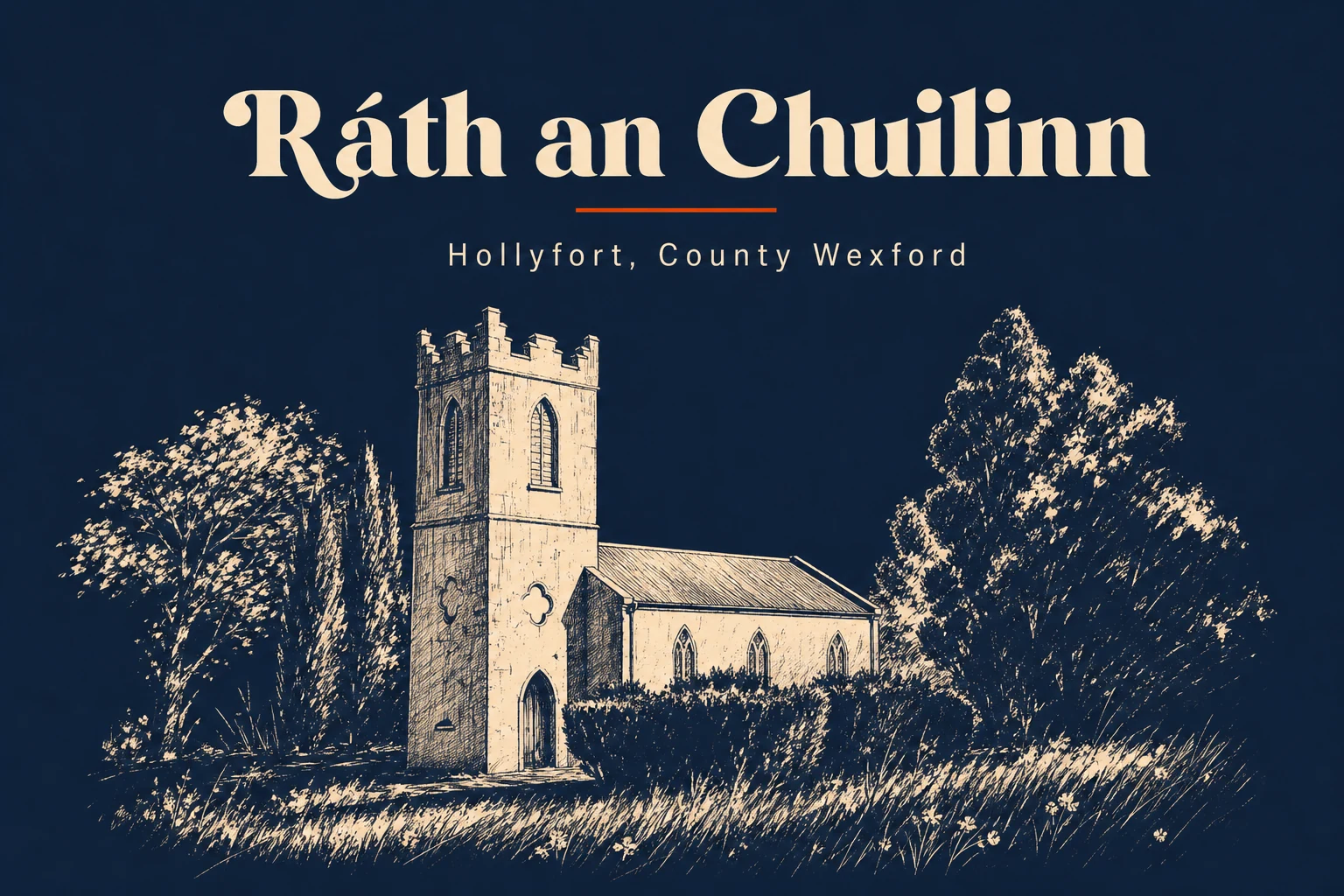
A place-name without a place
The ringfort of the holly
Ráth an Chuilinn translates as 'the ringfort of the holly'. Ringforts - circular earthen enclosures around a single farmstead - were the standard rural settlement form in Ireland from roughly the early-medieval period through to about 1000 AD. There are tens of thousands of them across the country, most invisible from ground level after centuries of ploughing. The Hollyfort fort is one of those. The holly tree it was named for is gone too. The village kept the name and the river kept running, and that's the whole inheritance.
The river the village hides on
Trout on the Bann
The Bann here is a small spate river, fast after rain and skinny in a dry summer. It holds wild brown trout - small fish, mostly under the pound, but as wild as you'll find. Anglers come up from Gorey and out from Wexford town to fish the upper Bann around Hollyfort and Coolafancy on a May evening. Local clubs manage stretches of it. The fishing is the unwritten reason the village has a name beyond a postcode.
The parish around it
Kilnahue
Hollyfort belongs to Kilnahue civil parish - Cill na hUamha, the church of the cave. The parish church is a few miles away. This is the rural Ireland of parish football, GAA pitches in townland fields, and dispersed settlement rather than nucleated villages. Hollyfort is one of three or four crossroads in the parish that picked up a name on a map. There are dozens more without one.