County Wexford Ireland · Co. Wexford · Killinierin Save · Share
POSTED FROM
KILLINIERIN
CO. WEXFORD · IE

Killinierin
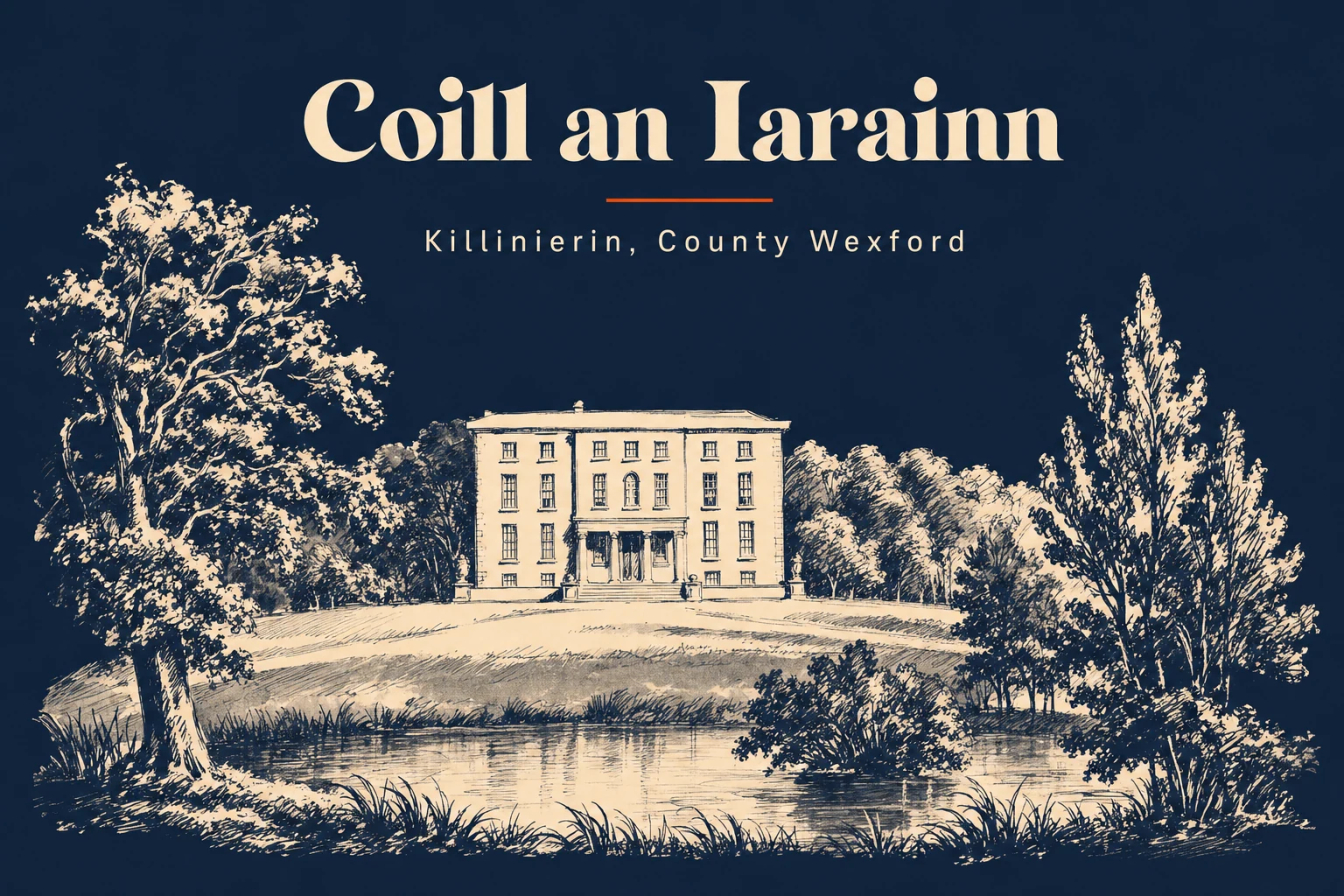
Coill an Iarainn, Co. Wexford

The Ireland's Ancient East
STOP 02 / 03
Coill an Iarainn · Co. Wexford

Wood of the iron, in the lee of a mountain that once had a gold rush.

Killinierin is a village you'd drive past if the road went through it, which the N11 does not - it sits four kilometres west, a turn off the main road towards Inch and the hills. Two-seventy people at the last count. A church, a school, a graveyard with the Esmondes in it, and the lanes climbing west into the foothills of Croghan.

What the place has is its name - wood of the iron - and a mountain on the skyline that had its fifteen minutes in 1795 when a gold rush broke out on its lower slopes. The Esmonde family of Ballynastragh ran the parish from the big house for three centuries until the anti-Treaty IRA burned it down in March 1923. The house is gone. The plaque inside the chapel still lists them with the other benefactors. The country goes on like that.
Population
270
Walk score
Church, school, pub - ten minutes end to end
Coords
52.7544° N, 6.3361° W
01 / 05

At a glance.

Three things every local will eventually mention. Read these and you've already understood more than most day-trippers do.

02 / 05

Stories & lore.

The reason to come back. The things every local will eventually tell you about, usually after the second pint.

Croghan Kinsella

The 1795 gold rush

A peasant boy found a nugget in a stream on the south side of Croghan Kinsella mountain in the summer of 1795. By autumn the streambeds were full of people panning. Around 2,500 ounces came out before the crown took the workings over the following year - and then the rebellion of 1798 ended the whole affair. Nobody has ever found the mother lode. People still try.

The big house, 1923

Ballynastragh

Ballynastragh House was the seat of the Esmondes - a family who had been in north Wexford since the 17th century and whose 1,500-acre estate of Lemanagh once stretched up to the village. The house was burned by anti-Treaty IRA on the 9th of March 1923, in the closing weeks of the Civil War. Sir Thomas Grattan-Esmonde rebuilt it, but smaller. The era was over either way.

The chapel, 1863

Pugin and Ashlin

St Peter and Paul's was built in 1863 to a design by E.W. Pugin - son of the more famous Augustus - and his Irish partner George Ashlin. The two of them did dozens of churches across Leinster in the decades after Catholic Emancipation. The Esmondes paid for a good chunk of it. Their names are on a plaque inside.

03 / 05

When to go.

There is no bad time. There are different times.

Spring
Mar-May

Lambs in the fields up the Croghan road. Long evenings start in April.

◉ Go
Summer
Jun-Aug

The lanes are at their best. The Owenavorragh and the local streams fish well after rain.

◉ Go
Autumn
Sep-Oct

Quiet, golden, the kind of light you stop the car for. Croghan turns colour from the top down.

◉ Go
Winter
Nov-Feb

Short days, wet lanes, nothing much open. Pass through unless you live nearby.

◐ Mind yourself
04 / 05

What to skip.

Honestly? Don't bother.

If a local was sitting beside you, this is the bit where they'd lean in.

×
Looking for a high street

There isn't one. It's a chapel, a school, and a graveyard at a crossroads. Don't drive in expecting shops.

×
Climbing Croghan in cloud

It's only 606 metres but the cloud comes down fast on the open ground up top. Pick a clear day or pick a different walk.

+

Getting there.

By car

Off the N11 between Gorey and Arklow - take the Inch exit and west for 4 km. Gorey is 12 km south, Arklow 10 km north.

By bus

Nearest Bus Éireann stop is on the N11 at Inch. Local Link 383 (Gorey-Aughrim) passes through some days - check the timetable.

By train

Nearest station is Gorey, 15 minutes by car. Then taxi or lift.