County Wexford Ireland · Co. Wexford · Camolin Save · Share
POSTED FROM
CAMOLIN
CO. WEXFORD · IE

Camolin
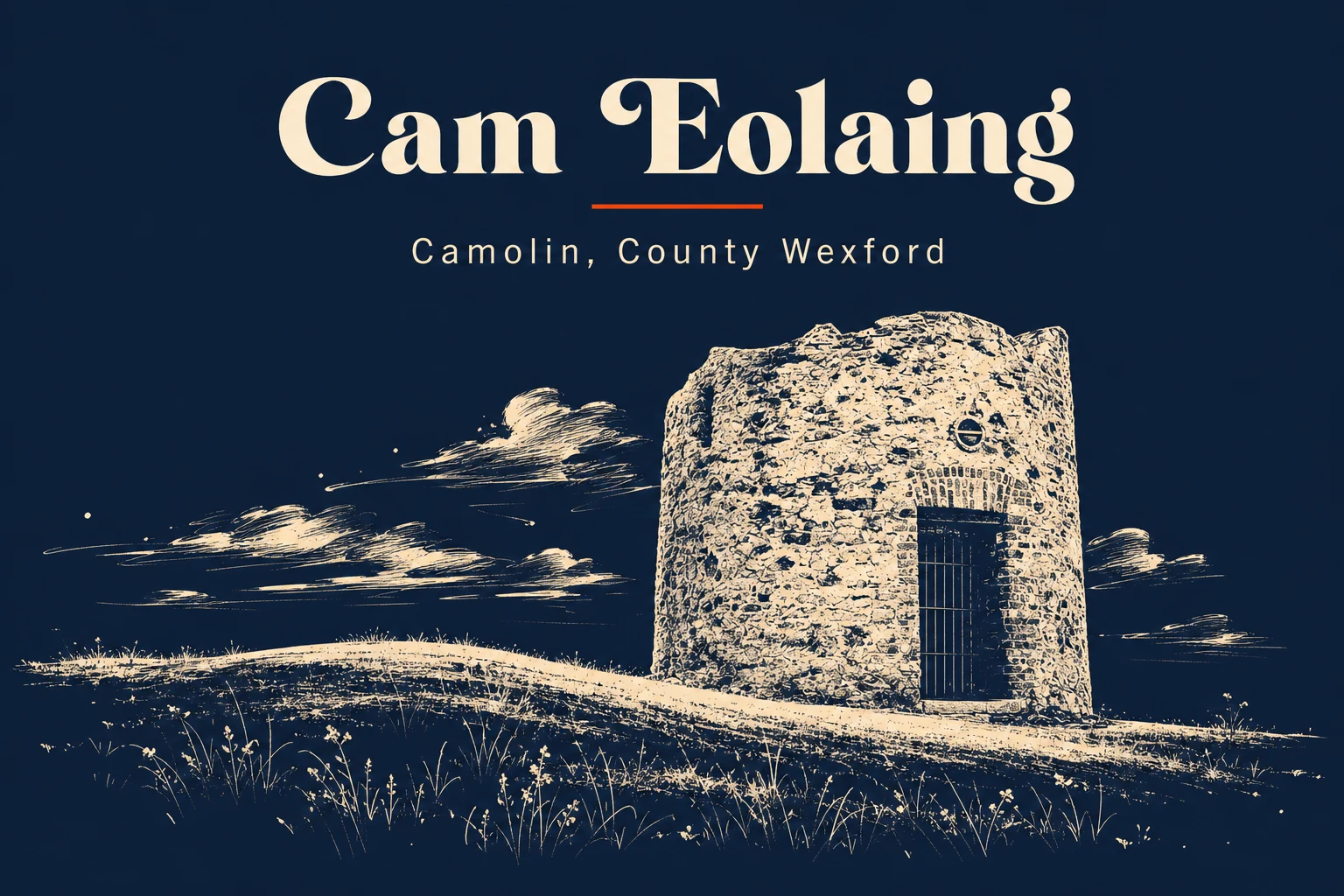
Cam Eolaing, Co. Wexford

The Ireland's Ancient East
STOP 21 / 21
Cam Eolaing · Co. Wexford

A one-street village on the old N11 with the 1798 Rebellion in its name.

Camolin is a single street between Ferns and Gorey, in the valley of the river Bann. For a long time the N11 was its main street and most people met it through a windscreen. Since the M11 bypass opened in 2019 the lorries have gone elsewhere and the village has its quiet back.

The name carries more weight than the place. The Camolin Cavalry - a local yeomanry corps raised in the 1790s by the Earl of Mountnorris from Camolin Park - gave its name to the patrol that on the night of 26 May 1798 burned a cabin at the Harrow and met an ambush led by Father John Murphy. That ambush is where the 1798 Rebellion is reckoned to have begun. Boolavogue is a few miles south. The whole landscape around here is a 1798 landscape - pubs and crossroads with stories tied to specific dawns in May and June of that year.

Today Camolin is a working village - a pub, a restaurant beside a garden centre, a few shops, a primary school. People stop on the way somewhere else. That's fine. The story is in the name, and the road is finally quiet enough to read it.

Population
~415 (2016 census; CSO 2022 not separately published for the village)
Walk score
Main street, end to end, in seven minutes
Founded
7th-century church of St Mo Ling - village grew on the Dublin-Wexford road
Coords
52.6167° N, 6.4333° W
01 / 07

At a glance.

Three things every local will eventually mention. Read these and you've already understood more than most day-trippers do.

02 / 07

The pubs.

None of these are themed Irish pubs, because they don't need to be. A few that earn the trip:

Jack's Tavern

Family-run, sport on, food until late
Pub & restaurant

On the main street. Run by Jack and Hilda Redmond and family since 2002. Pub grub, pizza, screens for the matches, a beer garden out the back called Jack's Outback. Music some Friday and Saturday nights. The village local in the working sense.

03 / 07

Where to eat.

PlaceTypeLocal note
Bay Tree Restaurant Café & restaurant €€ At Cois na hAbhann garden centre on the Clonhenret side of the village. Breakfast, lunch, coffee, cakes - the kind of place where people meet halfway between Gorey and Enniscorthy. Outdoor seating, garden centre attached.
04 / 07

Stories & lore.

The reason to come back. The things every local will eventually tell you about, usually after the second pint.

A village, a yeomanry, a war

The Camolin Cavalry

Raised in 1796 by Arthur Annesley, Earl of Mountnorris, of Camolin Park. By June 1798 the corps numbered around 65 troopers and 68 horses, drawn from the Protestant tenantry around the village. On 26 May 1798 a patrol under Lieutenant Bookey rode south from Camolin and burned a cabin at the Harrow, near Boolavogue. The ambush that followed - led by Father John Murphy - killed Bookey and a trooper named Donovan. That fight is the first action of the 1798 Wexford Rebellion. The unit kept going through the rest of the year. The village kept its name.

The blacksmiths who armed the rising

The pikes

The Wexford rebellion ran on pikes - long ash shafts with an iron head, often hooked to cut a horse's reins. The heads were forged at parish forges across the county, Camolin among them. There's no museum to it here, but the local 1798 trail and books like Eamon Doyle's Tales of the Anvil keep the names of the smiths who did the work. Many of those forges were running by night through the spring of 1798. Many of the men who carried the pikes never came back from Vinegar Hill.

The N11, then the M11

The road

Camolin grew up as a stop on the Dublin-Wexford road. For two centuries that meant coaches, then lorries, then a near-constant N11 of holidaymakers heading to Rosslare. The M11 motorway extension from Gorey to Enniscorthy opened on 18 July 2019 and lifted the through-traffic off the village street overnight. Whether that's good or bad depends who you ask - the shops lost the casual stop, the residents got their nights back. The village is still working it out.

05 / 07

When to go.

There is no bad time. There are different times.

Spring
Mar-May

The 1798 anniversary falls in late May - the Harrow and Boolavogue commemorations are nearby and worth catching.

◉ Go
Summer
Jun-Aug

Long evenings, the Bay Tree's outdoor seating in use, Gorey and Courtown twenty minutes away if you want a beach.

◉ Go
Autumn
Sep-Oct

Quiet. The countryside around Ferns and Camolin Park Forest is at its best in the turn of the leaves.

◉ Go
Winter
Nov-Feb

Not much happens in winter. A pint in Jack's, a drive on, that's about it.

◐ Mind yourself
06 / 07

What to skip.

Honestly? Don't bother.

If a local was sitting beside you, this is the bit where they'd lean in.

×
Looking for a 1798 visitor centre in the village

There isn't one. The proper centre is at Enniscorthy (National 1798 Centre) and the Father Murphy Centre is at Boolavogue. Camolin gives the unit its name, not the museum.

×
Camolin Park as a tourist site

The Annesley house was demolished and the estate was sold to the Land Commission. It's now Camolin Park Forest - over 600 acres of conifer plantation. Fine for a walk, not a stately home.

×
Treating it as a destination on its own

Camolin is a stop on a 1798 day, not a day in itself. Pair it with Boolavogue, the Harrow, Ferns and Enniscorthy - that's the proper itinerary.

+

Getting there.

By car

Off junction 22 of the M11. Five minutes from Ferns, ten from Gorey, twenty from Enniscorthy. Dublin to Camolin is about 1h 20m on the M11.

By bus

Bus Éireann and Wexford Bus services on the Dublin-Wexford route stop at Ferns and Gorey rather than Camolin itself. Easiest is bus to Ferns, then taxi or short drive.

By train

Nearest station is Enniscorthy on the Dublin-Rosslare line. About 20 minutes by car from there.

By air

Dublin Airport is 1h 30m up the M11. Rosslare Europort is 45 minutes south for ferries from Wales and France.