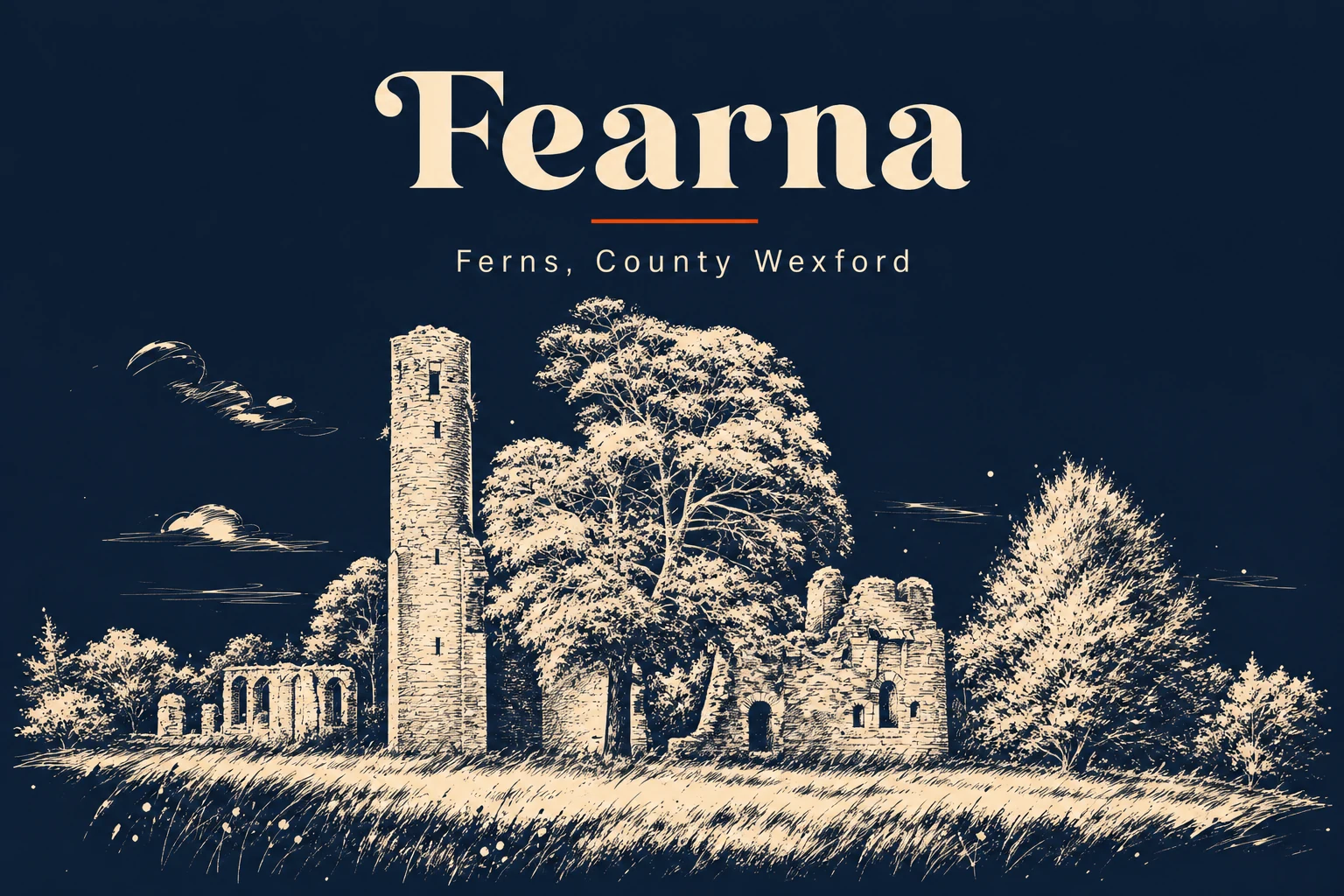
County Wexford Ireland · Co. Wexford · Ferns Save · Share
POSTED FROM
FERNS
CO. WEXFORD · IE

Ferns
Fearna, Co. Wexford

The Ireland's Ancient East
STOP 08 / 08
Fearna · Co. Wexford

Ancient capital of the Kingdom of Leinster. The man who let the Normans in is buried here.

Ferns is a one-street village now, on the old N11 between Enniscorthy and Gorey. Drive through it in three minutes and you would not know what happened here. What happened here is most of the 12th century.

Diarmait Mac Murchada - Dermot MacMurrough - was King of Leinster from 1127 until his death in 1171, and Ferns was his capital. He founded the Augustinian abbey here around 1158 for the health of his soul. He lost his kingdom to a coalition of Irish kings in 1166, sailed for England, and came back two years later with a borrowed Norman warlord called Richard de Clare - Strongbow - and a small army. The country never quite went back to what it was. Diarmait died at Ferns in May 1171 and is buried in the cathedral graveyard. There is a high cross shaft above what is reputed to be the grave. The locals will tell you it is.

Fifty years after Diarmait's death, William Marshal, the great Anglo-Norman knight who had married Strongbow's daughter and inherited Leinster, built the stone castle that still half-stands at the top of the village. Square plan, four round corner towers, one tower with a circular chapel cut into it that survives in nearly perfect condition. The Marshalls held it until the Irish Kavanaghs burned it in 1346, took it back, and ran the town until the Tudor crown reasserted itself in 1540. Most villages have a story. Ferns has a hinge - the place where Gaelic Ireland and Norman Europe collided and the rest of Irish history fell out the other side. Come for the stones; stay because of what they mean.

Population
1,317 (CSO 2022)
Walk score
Castle to cathedral graveyard in eight minutes
Founded
Monastery c. AD 598
Coords
52.5897° N, 6.4994° W
01 / 08

At a glance.

Three things every local will eventually mention. Read these and you've already understood more than most day-trippers do.

02 / 08

The pubs.

None of these are themed Irish pubs, because they don't need to be. A few that earn the trip:

The Courtyard

Locals, food-led
Pub & restaurant, est. 1997

On Main Street, the obvious one. Bar, restaurant (Dandy Pat's Bistro inside), beer garden. The Festival of Ferns runs music here in late May. If you want a pint after the castle, this is where you have it.

03 / 08

Where to eat.

PlaceTypeLocal note
Dandy Pat's Bistro Bistro at The Courtyard €€ The kitchen inside The Courtyard. Bar food at lunch, fuller plates in the evening. Not a destination restaurant - but the only place in the village that is not a chip shop, and the chowder will not embarrass anyone.
04 / 08

Stories & lore.

The reason to come back. The things every local will eventually tell you about, usually after the second pint.

The man who invited the Normans

Diarmait

Diarmait Mac Murchada was King of Leinster from 1127. By 1166 he had been driven out by a coalition under Ruaidrí Ua Conchobair, the High King - there was a stolen wife somewhere in the back of it, the Abbess of Kildare, his neighbour Tighearnán Ua Ruairc nursing the grudge for fifteen years. Diarmait sailed for Bristol, found Henry II in Aquitaine, got a letter of permission, and recruited Richard de Clare - Strongbow - with the offer of his daughter Aoife in marriage and the kingdom after his death. The Normans landed in Wexford in May 1169. By 1171 Diarmait was dead and buried in the cathedral graveyard at Ferns and Strongbow was Lord of Leinster. The high cross shaft in the graveyard is reputed to mark his grave. The story Irish schoolchildren learn - that he sold the country - is the simple version. The slightly less simple version is that he played a regional power game and the table tilted.

The founder, also called Mogue or Maedóc

St Aidan of Ferns

The monastery at Ferns was founded around AD 598 by St Aidan - known locally as Mogue, or Maedóc, or in scholarship Máedóc of Ferns. He was a Cavan man, born on an island in Templeport Lake, trained at St David's in Wales, and granted the land at Ferns by King Brandubh of the Uí Cheinnselaig after a battlefield favour. He became the first Bishop of Ferns. The diocese named after him is still a Catholic see today.

The greatest knight

William Marshal

William Marshal married Isabel de Clare, Strongbow's daughter, in 1189 and inherited Leinster through her. He built the stone castle at Ferns around 1220 to plant a Norman fist on Diarmait's old capital. Square keep, four round corner towers, vaulted chapel built into one of them. Marshal himself was probably the most celebrated knight in medieval Europe - tournament champion, regent of England for the boy-king Henry III, the man who held the realm together after Magna Carta. He is not buried here. But the castle is his.

When the Irish came back

The Kavanaghs and 1346

The Marshalls and their successors held Ferns Castle until 1346, when the Irish clans - the Kavanaghs descended from Diarmait's own line - burnt it and took it back. They held the town and the castle for the next two centuries until the Tudor reconquest under Henry VIII reabsorbed it in 1540. The castle never recovered its full form. What you see today is essentially what the wars of the 1640s left standing - half a keep, one good tower, and a chapel that survived everything.

05 / 08

Things to do outside.

Wear waterproofs. Bring a sandwich. Tell someone where you're going if it's the mountain.

Ferns Castle grounds Free to walk, OPW-managed. The southeast tower is the one to climb if you can - a guided tour in season takes you up through the vaulted chapel to a parapet view of the village. The visitor centre at the base has the Ferns Tapestry, a hand-stitched 1,000-year history of the village.
15 mindistance
15-30 mintime
Cathedral graveyard Round the back of St Edan's. The medieval cathedral fragments sit in the field, knee-high in nettles. The high cross shaft over Diarmait's reputed grave is the one most people are looking for. There are also early Christian high crosses worth finding - ask in the visitor centre.
20 mindistance
20-40 mintime
St Mary's Abbey The Augustinian abbey Diarmait founded around 1158, dissolved in 1539. A square-base round-top belfry tower survives, along with a vaulted chancel. Five minutes' walk down from the castle. Unmanned, free, atmospheric in the rain.
5 min from the castledistance
15 mintime
06 / 08

When to go.

There is no bad time. There are different times.

Spring
Mar-May

The Festival of Ferns is late May - medieval re-enactment in the castle grounds, free music in the village. The best weekend of the Ferns calendar by some distance.

◉ Go
Summer
Jun-Aug

The OPW castle tours run reliably. Long evenings and the village is at its best - though it is still a ten-minute village, so do not over-budget the day.

◉ Go
Autumn
Sep-Oct

Quiet, gold light over the castle stone, the cathedral graveyard at its most graveyard. The locals' season.

◉ Go
Winter
Nov-Feb

The castle visitor centre and tower tours close from late autumn. You can still walk the grounds and the graveyards in any weather, but the interpretation goes dark.

◐ Mind yourself
07 / 08

What to skip.

Honestly? Don't bother.

If a local was sitting beside you, this is the bit where they'd lean in.

×
Trying to make a full day of Ferns alone

It is a half-day stop. Castle, graveyard, abbey, lunch at The Courtyard, you are done by three. Pair it with Enniscorthy (15 minutes south) or Gorey (15 minutes north).

×
Expecting a town the size of its history

Ferns ruled Leinster for centuries. It is now a village of 1,317 people. The disconnect is the point - accept it, do not be disappointed by it.

×
The 'reputed' grave as a checkable fact

The high cross shaft is genuinely medieval. Whether Diarmait is buried directly beneath it is a tradition, not a verified fact. Treat it as a marker, not a tomb.

×
Confusing the diocese with the village

The Catholic Diocese of Ferns covers most of Wexford and was at the centre of the 2002 Ferns Report into clerical abuse. That is a serious chapter in modern Irish history; it does not happen to be in this village. Do not treat the village as a memorial it is not.

+

Getting there.

By car

On the old N11, now bypassed by the M11 - exit at Junction 22 or 23 and the village is one minute off the motorway. Dublin is 1h 30m. Wexford town is 25 minutes south. Rosslare ferry is 45 minutes.

By bus

Bus Éireann 2 (Dublin-Wexford) and the Wexford Bus 740 stop in the village several times a day. Twenty minutes from Enniscorthy, fifteen from Gorey.

By train

Nearest station is Enniscorthy (15 minutes by car/bus) on the Dublin-Rosslare line.

By air

Dublin Airport is 1h 45m by car. Rosslare ferry port is 45 minutes for arrivals from Wales or France.