County Wexford Ireland · Co. Wexford · Oulart Save · Share
POSTED FROM
OULART
CO. WEXFORD · IE

Oulart
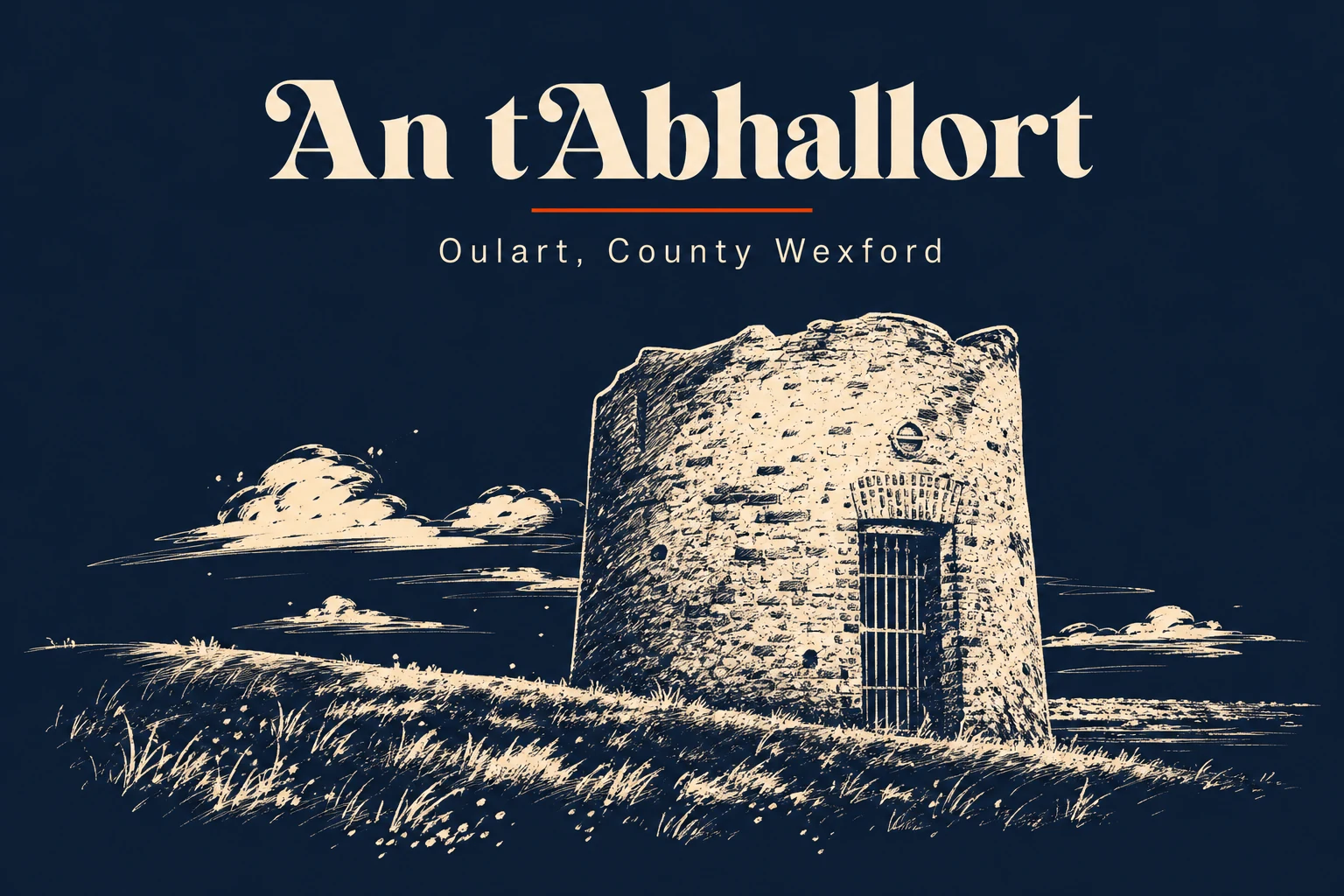
An tAbhallort, Co. Wexford

The Ireland's Ancient East
STOP 07 / 07
An tAbhallort · Co. Wexford

27 May 1798. A thousand pikes, a hill, a militia wiped out. The rebellion had its first win.

Oulart is a small crossroads village in north-central Wexford with a Catholic church, a GAA pitch, a couple of pubs, and a hill behind it that decided the shape of the summer of 1798. Drive through it on the R741 between Gorey and Wexford and you'll miss it in twenty seconds. Turn off, drive up the lane to the car park at the top of the hill, and the whole geography of the Wexford rebellion lays itself out below you - Boolavogue to the north, Ferns and Enniscorthy to the west, Wexford town and the sea to the south.

What happened here on 27 May 1798 was the rebellion's first real victory. Father John Murphy of Boolavogue had spent the previous night gathering people on the hill after the Camolin yeomanry burned his chapel. Roughly a thousand assembled by morning - mostly farm labourers with pikes and reaping hooks, a few muskets between them. The North Cork Militia came up from Wexford to scatter them. The rebels feinted retreat, the militia followed onto the open summit, and the rebels turned and broke them. All but five of the 110 militiamen were killed. Within a week most of north Wexford was in arms.

The hill today is calm pasture and a marked walking trail with twenty-five memorial stones along the path. The big thing on the summit is Tulach a' tSolais - the Mound of Light - by sculptor Michael Warren and architect Ronnie Tallon, finished for the bicentenary. It is one of the more thoughtful pieces of public sculpture in the country: not a triumphal arch, not a pikeman with his fist in the air, but an earthen mound bisected by a passage, with the light reading as the Enlightenment ideas the rebellion was supposed to be about. Walk up at dusk in May and the wind does most of the talking for you.
Population
274 (Census 2016)
Walk score
Crossroads village - five minutes end to end
Founded
Parish village; battle of 27 May 1798 fixed its name in history
Coords
52.5333° N, 6.3833° W
01 / 07

At a glance.

Three things every local will eventually mention. Read these and you've already understood more than most day-trippers do.

02 / 07

The pubs.

None of these are themed Irish pubs, because they don't need to be. A few that earn the trip:

Byrnes

Local
Village pub

One of the handful in the village proper. Standard country pub - sport on the telly, GAA conversations, a fire in winter. Hours vary; quietest in the afternoon.

Oulart Hill Bar

Local
Village bar

Next to the Oulart-the-Ballagh GAA grounds. Lifts on match nights and quietens the rest of the time. Best information point for who's around and what's open.

03 / 07

Stories & lore.

The reason to come back. The things every local will eventually tell you about, usually after the second pint.

27 May 1798

The morning on the hill

Father Murphy had retreated to Oulart Hill overnight with his parishioners after the burning of his chapel at Boolavogue. By morning the gathering had grown to perhaps a thousand. Colonel Foote was sent from Wexford with 110 men of the North Cork Militia and a small yeomanry detachment to disperse them. The rebels first appeared to retreat over the brow of the hill. The militia followed up the slope and over. On the far side the rebels were waiting in a line behind a ditch. The militia fired one volley, the rebels charged with pikes, and the engagement was over in minutes. Foote and four men reached Wexford. The other 105 did not. The rebels picked up about a hundred muskets and the rebellion had its arms.

The Mound of Light, 1999

Tulach a' tSolais

Sculptor Michael Warren of Gorey and architect Ronnie Tallon of Scott Tallon Walker were commissioned for the bicentenary of the Rising in 1998. What they built is a long earthen mound on the summit, bisected by a stone passage opening east and west, with an internal chamber holding two curving planes of 200-year-old Irish oak sized to the golden ratio. The first sod was turned on 27 May 1998 by Jean Kennedy Smith, then US ambassador. The monument was officially opened by the Minister for Finance Charlie McCreevy on 23 May 1999. Warren died in 2022. Tallon died in 2014. The thing they made together still works.

27 May-2 July 1798

Father Murphy after Oulart

The victory at Oulart Hill put Murphy at the head of a rebellion he had spent months trying to prevent. Within days the rebel army took Enniscorthy and then Wexford town. By mid-June they held most of the county. On 21 June General Lake's army broke them at Vinegar Hill outside Enniscorthy. Murphy and a small band went on the run through Wicklow and Carlow. They were captured in a farmyard near Tullow on 2 July, tried in the afternoon, and executed the same day. He was forty-five. The headstone at Ferns marks a coffin; the body itself was burned in a barrel of tar in the square at Tullow.

04 / 07

Things to do outside.

Wear waterproofs. Bring a sandwich. Tell someone where you're going if it's the mountain.

Cosán na Glóire (Path of Glory) From the summit car park along the level top of the hill to Tulach a' tSolais and back. Suitable for buggies and older walkers. Best at sunset - the passage was designed so the light reads.
About 1 km returndistance
20-30 mintime
Jean Kennedy Smith Walk Looped trail down off the hill into Oulart village and back up. Passes the 1898 centenary monument and the grave of the six insurgents in the village, the Tree of Liberty planted by Jean Kennedy Smith in 1995, then climbs back to Tulach a' tSolais.
About 6 km loopdistance
1h 30m-2htime
The Unyoke Walk From Oulart Hill down to Blackwater village along the source of the Aughinall River. Three kilometres of the route follow the old untouched medieval Wexford-Dublin coach road. Arrange a lift back or walk it as an out-and-back from either end.
11 km lineardistance
3-4 hourstime
05 / 07

When to go.

There is no bad time. There are different times.

Spring
Mar-May

May is the right month. The battle was on the 27th, and the local 1798 commemorations cluster around that weekend. The light through the Tulach a' tSolais passage is at its best as the sun lowers.

◉ Go
Summer
Jun-Aug

Long evenings, dry trails, panoramas south to the sea. Pair the hill with Vinegar Hill at Enniscorthy and Boolavogue for the full 1798 day.

◉ Go
Autumn
Sep-Oct

Quiet on the hill, big skies, the country in colour. The car park is rarely full. A good time to walk it alone.

◉ Go
Winter
Nov-Feb

Exposed summit, wind off the Irish Sea, short daylight. The monument is open year-round but the trails get muddy. Bring boots and a wind layer.

◐ Mind yourself
06 / 07

What to skip.

Honestly? Don't bother.

If a local was sitting beside you, this is the bit where they'd lean in.

×
Looking for restaurants in Oulart itself

There aren't any worth driving for. Eat in Ferns, Enniscorthy or Gorey - all twenty minutes away - and treat Oulart as the hill, the trail and the monument.

×
Doing the hill in low cloud

The point of the summit is the panorama and the way the light cuts through the Tulach a' tSolais passage. In mist you see neither. Wait for a clear afternoon.

×
Confusing Oulart Hill with Vinegar Hill

Different battles, different outcomes, twenty kilometres apart. Oulart (27 May) was the rebel victory; Vinegar Hill (21 June) was the defeat that ended the Wexford rising. Both are worth a half-day. They're not the same hill.

+

Getting there.

By car

Off the R741 between Gorey and Wexford. From Enniscorthy it is about 20 minutes east on the R744 and R741. The hill car park is signed from the village - about a kilometre up the lane.

By bus

No direct service to the village. Bus Éireann and Wexford Bus run the N11 Dublin-Wexford corridor through Camolin and Ferns; nearest is Camolin, about 6 km north.

By train

Nearest stations are Enniscorthy and Wexford on the Dublin-Rosslare line. Both are about 25 minutes by road.

By air

Dublin Airport is just under 2 hours by car. Rosslare Europort is 35 minutes south.