County Wexford Ireland · Co. Wexford · Boolavogue Save · Share
POSTED FROM
BOOLAVOGUE
CO. WEXFORD · IE

Boolavogue
Buaile Mhaodhóg, Co. Wexford

The Ireland's Ancient East
STOP 19 / 20
Buaile Mhaodhóg · Co. Wexford

The 1798 Rebellion started here on a May night. The song is the rest.

Boolavogue is a townland and a name on a map more than it is a village. A crossroads, a church, a parish hall, a graveyard, a 1798 centre, and the country running away in every direction - north to Camolin, south to Ferns, west to Enniscorthy, east to nothing in particular. Drive through and you'll wonder what the fuss is. The fuss is what happened here on the night of 26 May 1798, and the song that came of it a hundred years later.

Father John Murphy was thirty-five when he was sent to be curate of Kilcormuck parish. He had studied for the priesthood in Seville. He had told his parishioners to hand in their pikes and take the oath of loyalty. He was, by every account, a man who wanted to be left alone. Then the Camolin Cavalry came through, and the chapels of north Wexford started burning, and on the morning of 27 May Father Murphy was at the head of a column of men with pikes marching on Oulart Hill. They wiped out the North Cork Militia there. Within weeks the rebellion ran from Gorey to New Ross. By July it was over, and Murphy had been taken near Tullow, hanged and beheaded and burned in a barrel of tar.

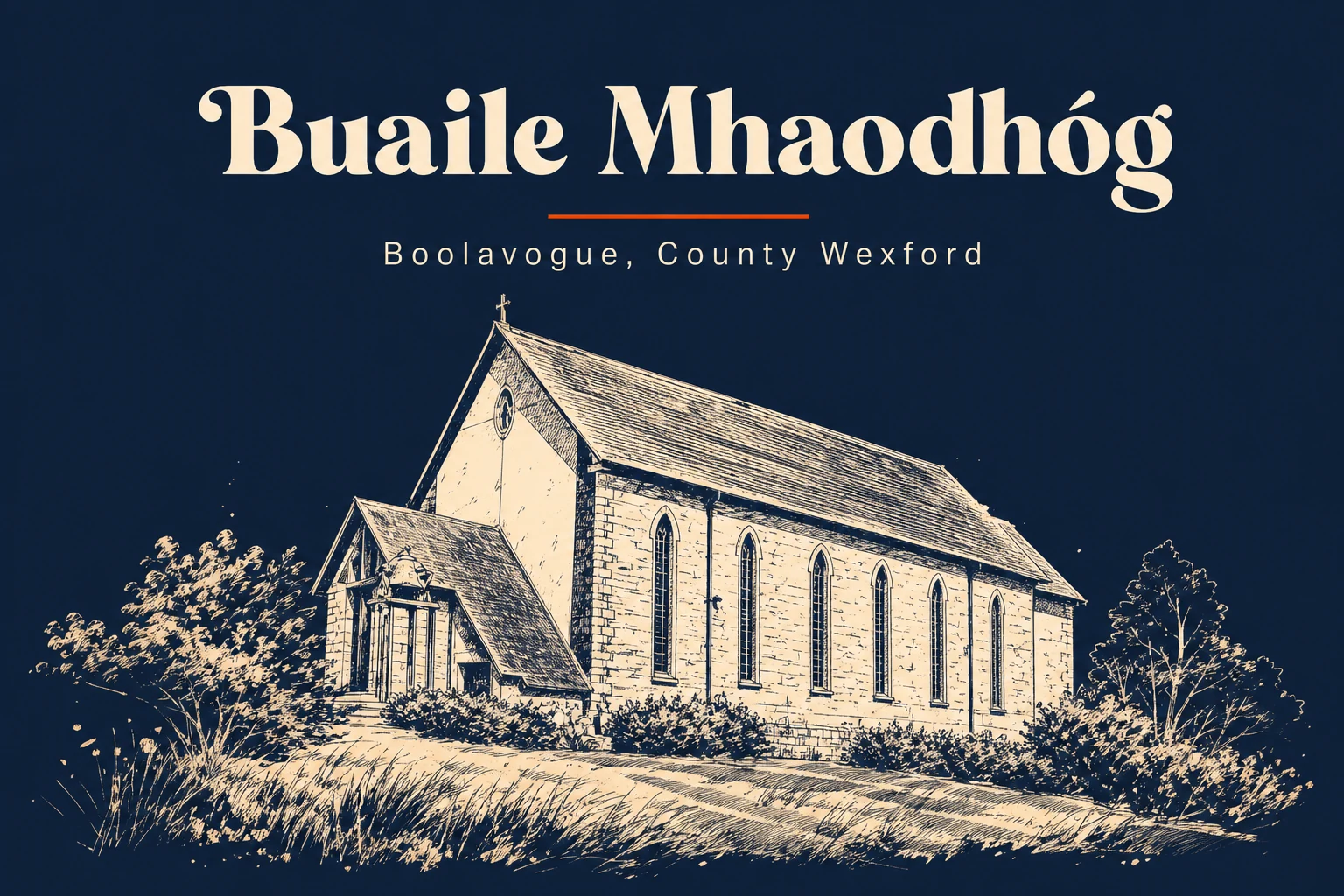
What you see today is the cottage on the spot, a museum that has been opened and renovated and quietly closed and opened again, a fine bronze monument outside, and the church of St Mogue on the rise. The Fr Murphy Centre is the reason most people stop. The song is the reason they know to. P.J. McCall wrote it in 1898 sitting in Dublin, never having lived in Wexford, working from family stories and a centenary commission. It is one of the most famous songs in the Irish language tradition and the only reason most outsiders can place a tiny crossroads in north Wexford on the map.
Population
Rural townland - a few dozen houses
Walk score
Crossroads, church, centre - five minutes end to end
Founded
Parish of Kilcormuck - Murphy curate from 1785
Coords
52.5667° N, 6.4500° W
01 / 05

At a glance.

Three things every local will eventually mention. Read these and you've already understood more than most day-trippers do.

02 / 05

Stories & lore.

The reason to come back. The things every local will eventually tell you about, usually after the second pint.

26 May 1798

The night the chapel burned

Father Murphy had spent weeks telling his parishioners to swear loyalty to the Crown and surrender their pikes. He believed it would protect them. It didn't. On 26 May 1798 a patrol of about twenty yeomanry under Lieutenant Bookey of the Camolin Cavalry rode through The Harrow, near Boolavogue, and set fire to a suspected rebel's cabin. Murphy and his people ambushed them. Bookey was killed. That night the yeomanry burned Murphy's own chapel at Boolavogue in reprisal. By morning he was leading the rebellion he had spent months trying to prevent.

27 May 1798

Oulart Hill, the next day

Murphy gathered his supporters on Oulart Hill, eight kilometres south. A detachment of 110 men of the North Cork Militia under Colonel Foote came up from Wexford town to disperse them. The rebels, perhaps a thousand strong with pikes and a few muskets, drew the militia onto the high ground and then turned. All but five of the militia were killed. Foote got back to Wexford with four men. The rebellion now had a victory and a leader, and within a week most of north Wexford had joined.

2 July 1798

The execution at Tullow

After Vinegar Hill fell on 21 June, Murphy and a small group went on the run through Wicklow and Carlow. They were taken in a farmyard near Tullow on 2 July. Brought before a military tribunal that same day, both were sentenced to death. Murphy was stripped, flogged, hanged, and beheaded; his body was burned in a barrel of tar opposite the local Catholic church and his head impaled on a spike. He was forty-five. The grave at Ferns holds a coffin; the bones are scattered.

P.J. McCall, 1898

"At Boolavogue, as the sun was setting"

Patrick Joseph McCall was a Dublin grocer's son and a poet. For the centenary of the Rising in 1898 he wrote the ballad first titled Fr Murphy of the County Wexford, set to the old air Eochaill - Youghal Harbour. It first appeared in the Irish Independent on 18 June 1898. The opening line - At Boolavogue, as the sun was setting / O'er the bright May meadows of Shelmalier - fixed the village name in every Irish schoolroom for a century. McCall is buried in Glasnevin. The song is buried in everyone.

03 / 05

When to go.

There is no bad time. There are different times.

Spring
Mar-May

May is the obvious month. The chapel burned on the 26th, Oulart Hill happened on the 27th, and the local 1798 commemorations cluster around then. Quiet otherwise - bring a flask.

◉ Go
Summer
Jun-Aug

The Fr Murphy Centre is most likely to be open. Long evenings let you walk the lanes Murphy walked, and Vinegar Hill at Enniscorthy is twenty minutes away.

◉ Go
Autumn
Sep-Oct

Hours at the Centre shorten. Check the Facebook page or ring before driving out - a closed gate is a long way for nothing.

◐ Mind yourself
Winter
Nov-Feb

The Centre is generally shut. The monument and graveyard remain. If you want a pilgrimage with no one else around, this is when to take it.

◐ Mind yourself
04 / 05

What to skip.

Honestly? Don't bother.

If a local was sitting beside you, this is the bit where they'd lean in.

×
Turning up at the Fr Murphy Centre without checking

Hours have changed several times since the renovation, and it has gone through quiet periods. The phone number is +353 53 946 6898 - use it before you drive.

×
Treating Boolavogue as a day-trip on its own

It's a crossroads with a story. Pair it with Vinegar Hill in Enniscorthy and the National 1798 Centre, or with Ferns up the road, and the day adds up. On its own it's twenty minutes.

×
Looking for a pub or restaurant in the village

There isn't really one to recommend. The nearest pints and food are at Ferns, four kilometres south, or Camolin a bit further north. Plan accordingly.

+

Getting there.

By car

From Enniscorthy take the R772 north toward Ferns and turn east at Ferns onto the local road - about 15 minutes. From Gorey, head south on the N11 to Camolin, then west, about 20 minutes.

By bus

No direct bus to Boolavogue itself. Bus Éireann and Wexford Bus run Dublin-Wexford services through Ferns and Camolin on the N11 - taxi or walk the last 4-5 km from there.

By train

Nearest stations are Enniscorthy and Gorey on the Dublin-Rosslare line. Both are about 20 minutes by road from the village.

By air

Dublin Airport is 2 hours by car. Rosslare Europort, for ferries, is 45 minutes south.