County Wexford Ireland · Co. Wexford · Monamolin Save · Share
POSTED FROM
MONAMOLIN
CO. WEXFORD · IE

Monamolin
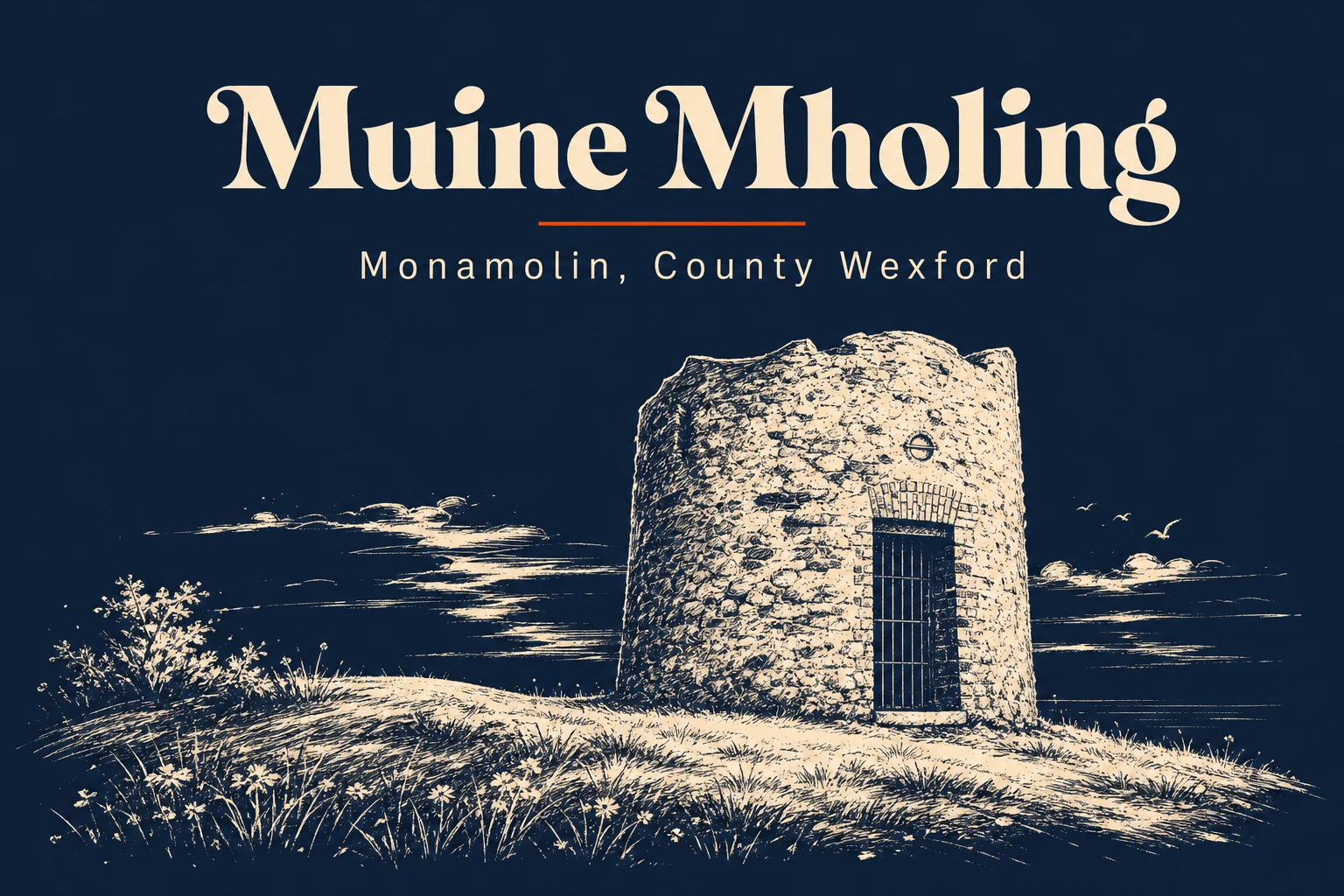
Muine Mholing, Co. Wexford

The Ireland's Ancient East
STOP 22 / 22
Muine Mholing · Co. Wexford

A south-Gorey crossroads named for a saint, in 1798 country.

Monamolin is a small village on the R741 between Gorey and the coast, in the rolling country south of Camolin. There is a church, a graveyard, a few houses at a crossroads, and a name that has been written down at least three different ways since Sir William Petty's surveyors came through in the 1680s. Most people pass through it on the way to Wells House or the beaches at Kilmuckridge and Blackwater, and most never knew they were in it.

The interesting thing is the name. Muine Mholing means the thicket - or scrub - of Mo Ling, a 7th-century saint who became Bishop of Ferns and gave his name to a whole region of south Leinster. The present Catholic church here is a 19th-century building, but the ground it stands on has had a church on it, on and off, since long before that. The 1798 Rebellion happened all around here - Oulart Hill is a few miles south, Boolavogue a few miles west - and Monamolin is in the landscape of the rising even if no specific action is recorded in the village itself. Come for that and stay for the quiet.
Population
Small rural village - civil parish population in the low hundreds
Walk score
Crossroads, church, a few houses - three minutes end to end
Founded
Named for St Mo Ling, 7th-century Bishop of Ferns - present Catholic church is 19th-century
Coords
52.5500° N, 6.3500° W
01 / 05

At a glance.

Three things every local will eventually mention. Read these and you've already understood more than most day-trippers do.

02 / 05

Stories & lore.

The reason to come back. The things every local will eventually tell you about, usually after the second pint.

The saint in the name

St Mo Ling

Mo Ling - sometimes written Moling or Mholing - was a 7th-century Irish saint who became Bishop of Ferns and founded a monastery at St Mullins on the Barrow in south Carlow. He turns up in early Irish hagiography, in the Book of Mulling (a pocket-sized Gospel manuscript associated with him), and in a litter of place-names across south Leinster. Monamolin is one of those names. The village's Catholic church carries his patronage; the surrounding civil parish has been called after him on maps since at least the 1650s.

Monemoling, Monemolin, Monomolin

The Down Survey

Sir William Petty's Down Survey of Ireland - the great Cromwellian land mapping of the 1650s - wrote the village down as 'Monemoling'. Samuel Lewis's Topographical Dictionary of Ireland in 1837 had it as 'Monemolin'. The 1851 General Alphabetical Index of Townlands settled on 'Monomolin' before the modern spelling won out. None of that is unusual for an Irish place-name; what's unusual is how clearly the original Mo Ling shows through every version.

A landscape, not a battlefield

1798

The Wexford Rebellion of 1798 started at the Harrow on the night of 26 May and was crushed at Vinegar Hill on 21 June. Almost every road around Monamolin leads, within a few miles, to a place that matters in that story - Boolavogue and Father John Murphy's chapel to the west, Oulart Hill where the rebels routed the North Cork Militia on 27 May to the south, Ferns and Enniscorthy beyond that. Monamolin itself saw no recorded engagement, but the parish would have lost men and houses like every other in north Wexford that summer. The proper way to see the village is as one stop on a 1798 day, not on its own.

03 / 05

When to go.

There is no bad time. There are different times.

Spring
Mar-May

Late May is the run-in to the 1798 commemorations at Boolavogue, Oulart and the Harrow - all within a short drive.

◉ Go
Summer
Jun-Aug

Long evenings and easy reach of the Kilmuckridge and Blackwater beaches. Wells House is at its best in summer too.

◉ Go
Autumn
Sep-Oct

Quiet country roads, hedges turning, very few cars on the R741.

◉ Go
Winter
Nov-Feb

Not much is open in the village itself. Treat it as a drive-through to somewhere else.

◐ Mind yourself
04 / 05

What to skip.

Honestly? Don't bother.

If a local was sitting beside you, this is the bit where they'd lean in.

×
Looking for a 1798 visitor centre

There isn't one here. The National 1798 Centre is at Enniscorthy and the Father Murphy Centre is at Boolavogue. Monamolin is in the landscape of the rebellion, not in its museum infrastructure.

×
Treating it as a destination

Monamolin is a name on a map and a church at a crossroads. Pair it with Wells House, Boolavogue, Oulart Hill and Ferns - that gives you a day. On its own it is fifteen minutes.

+

Getting there.

By car

On the R741 south of Gorey - about 11km via Camolin and the back roads, or come off the M11 at junction 22 (Camolin) or junction 23 (Ferns) and cut east. Wexford town is about 35 minutes south.

By bus

There is no direct village service that is reliably scheduled day-to-day; the practical option is the Bus Éireann or Wexford Bus service on the Dublin-Wexford route to Gorey or Ferns, then taxi or local lift.

By train

Nearest station is Gorey on the Dublin-Rosslare line, about fifteen minutes by car.

By air

Dublin Airport is 1h 30m up the M11. Rosslare Europort is 45 minutes south for ferries.