County Wexford Ireland · Co. Wexford · Ballygarrett Save · Share
POSTED FROM
BALLYGARRETT
CO. WEXFORD · IE

Ballygarrett
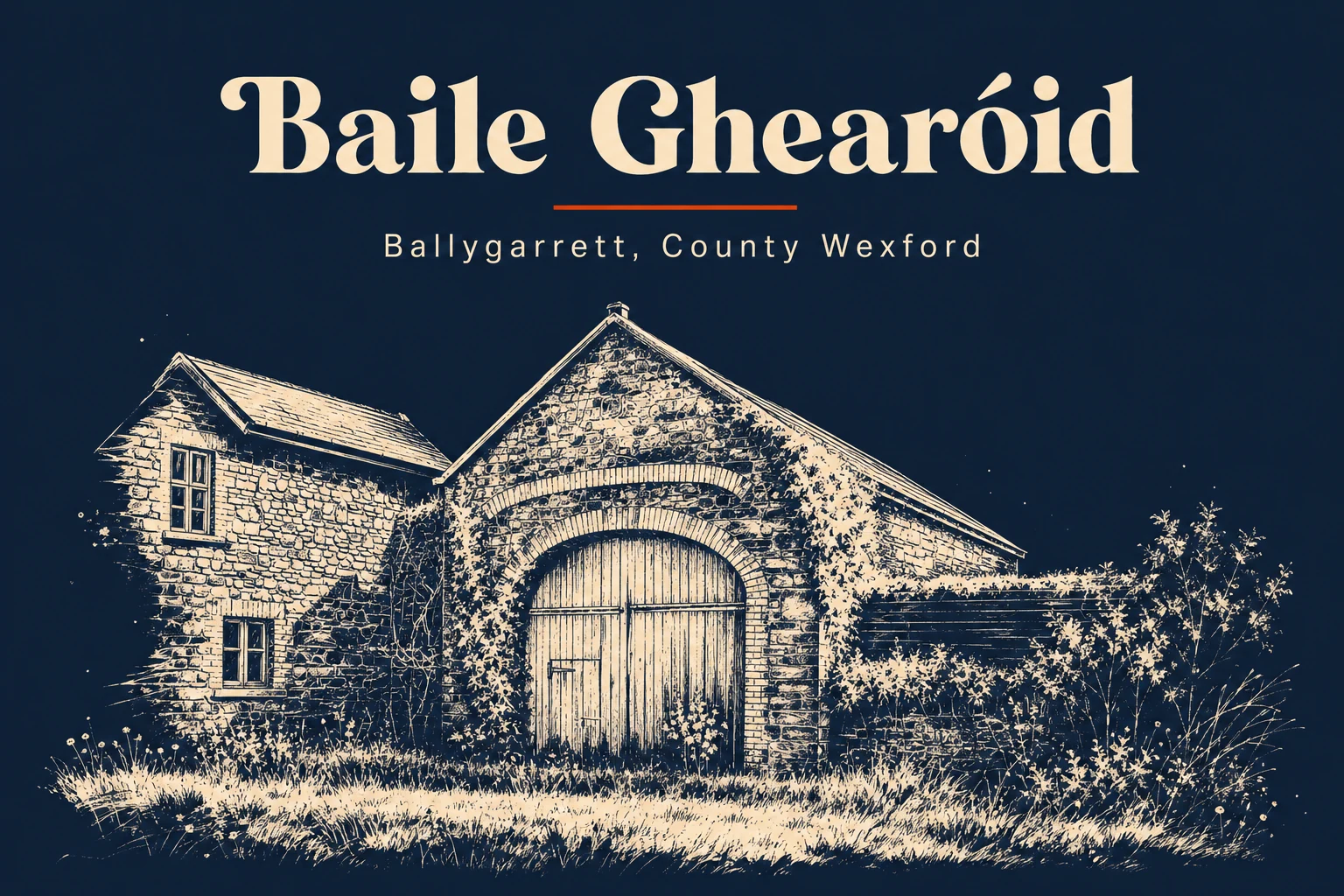
Baile Ghearóid, Co. Wexford

The Ireland's Ancient East
STOP 04 / 06
Baile Ghearóid · Co. Wexford

A crossroads parish two kilometres back from Cahore Pier, with a Texas town named after one of its sons.

Ballygarrett is one of those east-coast Wexford parish villages where the village proper is small enough to miss and the parish is the thing that matters. It sits on the R742, the inland coastal road that runs between Gorey and Kilmuckridge, on a low rise of land about two kilometres back from the sea. There is a church, a shop, a pub, a primary school and a scatter of houses along the road. You can walk the length of it in five minutes. The point is what is around it.

Two kilometres east is Cahore - a small working pier under a low clay cliff, a slipway, a long sand strand running south toward Old Bawn and Morriscastle, and, since 2019, a level cliff-top walk heading north out of the pier car park. The walk passes the cut-stone outline of an Éire sign laid out during the Second World War to tell drifting bombers and pilots which country they were over. The cliffs are soft glacial clay and the strand below them keeps quietly losing ground to the sea; the pier and the village above it have held their line.

The other thing Ballygarrett is known for is a man who left. James Power was born here in 1788, ended up in Mexican Texas in the 1820s, and as an empresario was granted the right to settle Irish Catholic colonists on the Gulf coast around what is now Refugio County. He brought hundreds of them across, mostly from Wexford. The two parishes have been twinned for years and the connection is still the first story most people in Ballygarrett will tell you about the place.
Walk score
Whole village in five minutes; Cahore Pier is two kilometres east
Coords
52.5667° N, 6.2333° W
01 / 06

At a glance.

Three things every local will eventually mention. Read these and you've already understood more than most day-trippers do.

02 / 06

Stories & lore.

The reason to come back. The things every local will eventually tell you about, usually after the second pint.

The Wexford man who founded a Texas county

James Power and Refugio

James Power was born in Ballygarrett parish in 1788. He emigrated as a young man, traded in New Orleans, then took Mexican citizenship and in 1828 secured an empresario grant with James Hewetson to settle Irish Catholic colonists on the Texas Gulf coast. The Power and Hewetson colony brought hundreds of Wexford and Tipperary families to the land around the Mission of Refugio in the 1830s. Power served at the Convention of 1836 that declared Texan independence. Refugio County, Texas, takes its name from the mission his colony settled around, and the modern town of Refugio is twinned with Ballygarrett.

Wartime navigation, written in stone

The Éire sign at Cahore

Walk fifteen minutes north along the Cahore Cliff Walk from the pier and the trail crosses a panel of cleared ground with the word ÉIRE picked out in white-painted stones. It is one of about eighty such markers laid along the Irish coast during the Second World War - neutral Ireland's way of warning Allied and Axis pilots above that the land below was not a belligerent. Many have been lost to erosion, farming and forgetting; the Cahore one was cleared and restored in the 2010s and is now a small landmark on the walk.

The parish on the rise

St Mary, Star of the Sea

The Catholic church in the village is St Mary, Star of the Sea - the dedication you get in coastal parishes where the sea is the thing that takes the men away and brings the men home. Inland Wexford goes for Saint Aidan or Saint Brigid; from Cahore down the coast you get Stars of the Sea. The church is the high point of the village street and the parish is named with it: Ballygarrett, Our Lady Star of the Sea.

03 / 06

Things to do outside.

Wear waterproofs. Bring a sandwich. Tell someone where you're going if it's the mountain.

The Cahore Cliff Walk From Cahore Pier car park, a level buggy-friendly trail opened in 2019 runs north along the top of the low clay cliffs. Passes the restored Second World War Éire sign about halfway along and ends near the northern field boundaries. Return the same way or drop back to the strand and walk under the cliffs on a low tide - but watch the soft clay above and the rising water below.
2.4 km one waydistance
1 hour one waytime
Cahore Strand to Old Bawn South from Cahore Pier along the sand below the clay cliffs toward the holiday-home strand at Old Bawn and on toward Morriscastle. Falling tide only and bring something to look at; there is no settlement in between. The cliffs are unstable in places and the sand keeps moving.
4 km one waydistance
1.5 hours one waytime
Village to pier Out the east road from the village down to Cahore Pier. A narrow country road with hedgerows and farm gates and a view of the sea opening up as you drop toward the slip. Slow traffic, no footpath - walk in early or late.
2 km one waydistance
25 minutestime
04 / 06

When to go.

There is no bad time. There are different times.

Spring
Mar-May

Quiet roads, empty strand, the cliff walk at its best before the summer dust on the path. The Wicklow Mountains show up clean on a north-westerly.

◉ Go
Summer
Jun-Aug

Cahore Pier car park fills early on a hot day. The strand south toward Old Bawn fills with the holiday-home crowd. Come midweek or come at eight in the morning.

◐ Mind yourself
Autumn
Sep-Oct

The sweet spot on this stretch of coast. Sea still warm into late September, the cliff walk to yourself, and the light off the water in October is the reason people come back.

◉ Go
Winter
Nov-Feb

The pier in a big easterly is worth seeing once, from the road. Don't stand under the clay cliffs in winter - they come down without warning. The village pub keeps going; most of the strand traffic is gone.

◐ Mind yourself
05 / 06

What to skip.

Honestly? Don't bother.

If a local was sitting beside you, this is the bit where they'd lean in.

×
Looking for a sea view from the village

Ballygarrett is two kilometres back from the water on a low rise. The sea is at Cahore, not in the village. Drive on for the view.

×
Standing under the clay cliffs at Cahore

They are soft glacial clay and they shed without warning. Walk the cliff top above them or the open strand well clear of the base. The local farmers will tell you the same thing.

×
Treating it as a substitute for Courtown

Courtown twenty minutes north has the harbour, the woods, the amusements and the lifeguarded Blue Flag beach. Cahore is a working pier and an empty strand. Pick the one that matches the day you want.

+

Getting there.

By car

Gorey to Ballygarrett is about 12 km south on the R742 - 15 to 20 minutes. Wexford town is about 35 km south, around 45 minutes by the R741 and R742. Dublin is roughly 100 km on the M11 to Gorey and out from there, around 1h 45m.

By bus

Local Link Wexford runs a limited service along the R742 corridor through the coastal villages. From Dublin take Bus Éireann to Gorey and connect locally; check times before you travel because the rural service is light.

By train

No station. Gorey on the Dublin Connolly-Rosslare Europort line is the nearest, about 15 minutes by car to the north. Wexford O'Hanrahan is about 40 minutes south.

By air

Dublin Airport (DUB) is about two hours by car via the M11. Rosslare Europort is around an hour south by road.