County Armagh Ireland · Co. Armagh · Jonesborough Save · Share
POSTED FROM
JONESBOROUGH
CO. ARMAGH · IE

Jonesborough
Baile an Chláir

The Ring of Gullion
STOP 06 / 06
Baile an Chláir · Co. Armagh

A border village whose Sunday market is half its identity and most of its traffic.

Jonesborough is a single street in a hollow five kilometres north of Dundalk, three minutes off the motorway, on the wrong side of a border that used to mean a lot more than it does now. Roth Jones, a Dublin barrister and the local landlord, laid out the village in 1706 on a spot that had been called Four Mile House — four miles from Dundalk, four miles from Newry, the natural place for a coach to stop.

What it is now, mostly, is the Sunday market. About 200 stalls fill the village green and the laneways around it from early morning till mid-afternoon, every Sunday of the year. It draws thousands. It has been doing that since before the Troubles and right through them and out the other side. The currency is whatever you have on you. The rule is haggle a bit but not much.

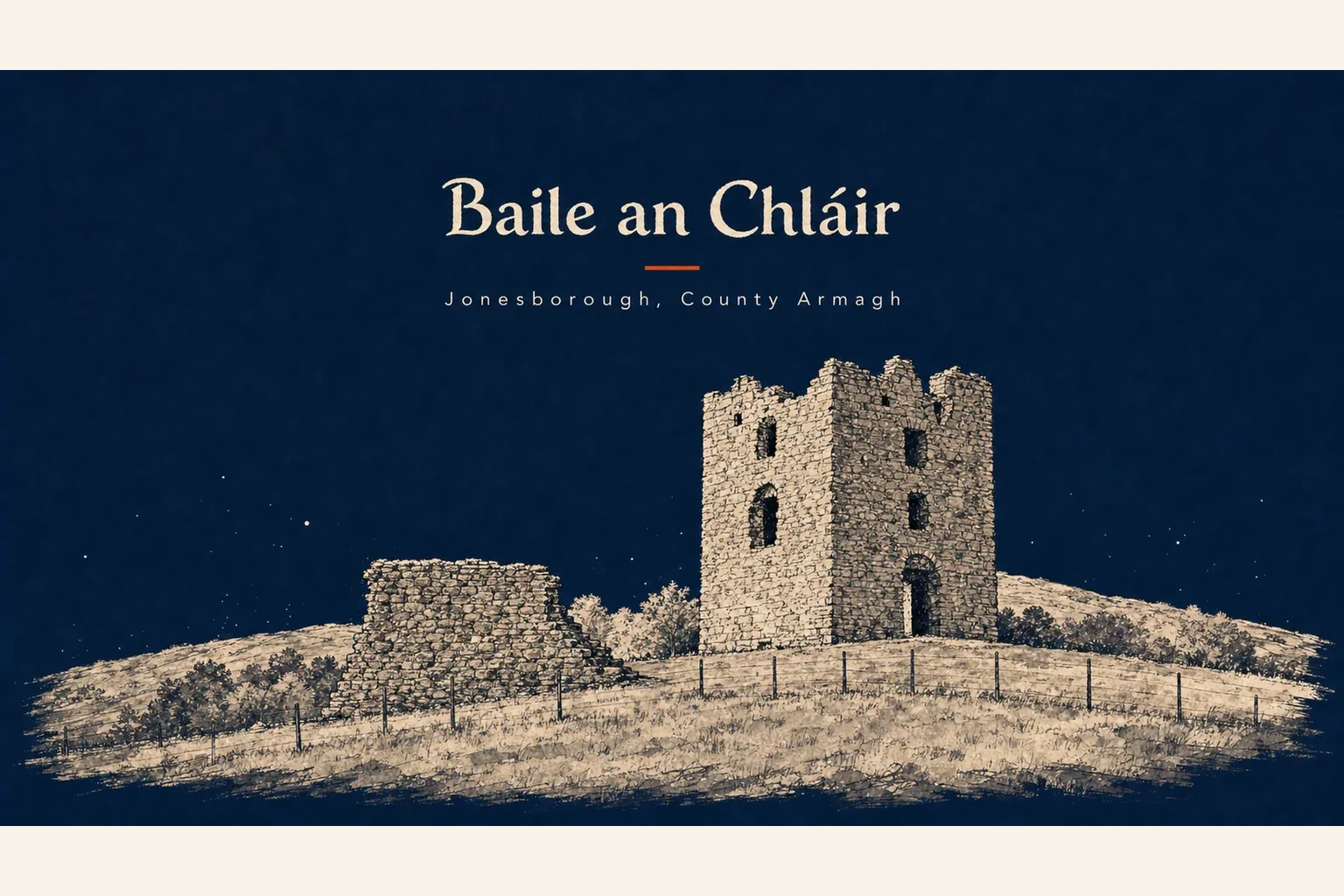
There are two other things worth knowing. One is that you are on the Gap of the North — the Moyry Pass — which is the road every army between Cú Chulainn and the British went through. The 1601 castle is still up there, a stub of a tower on a rock. The other is the Kilnasaggart Stone two kilometres down the lane, an eighth-century pillar with Ogham script and crosses cut into it, sitting in a field by itself. Most people who come for the market never see either. That is their loss.

Don't come on a Sunday afternoon expecting a quiet village. Don't come on a Tuesday expecting the market. Pick your day, mind your wallet at the stalls, and walk down the Edenappa Road afterwards.
Population
~750
Walk score
End to end of the village in five minutes
Founded
Laid out 1706 by Roth Jones
Coords
54.0833° N, 6.3833° W
01 / 06

At a glance.

Three things every local will eventually mention. Read these and you've already understood more than most day-trippers do.

02 / 06

Stories & lore.

The reason to come back. The things every local will eventually tell you about, usually after the second pint.

200 stalls, two currencies, no off-season

The Sunday market

The market runs every Sunday on and around the village green. It started small in the 1970s and grew into one of the biggest open-air markets on the island during the years when the price differential across the border was its own attraction. It survived the Troubles because the Troubles couldn't stop it — buses kept coming up from Dundalk, Drogheda, Dublin. Sterling and euro both spend. Bring cash. Anything that looks too cheap to be real probably is.

The road every army took

The Gap of the North

The Moyry Pass is the natural corridor between Ulster and Leinster, walled in by Slieve Gullion to the west and the Cooleys to the east. Edward Bruce went through it in 1315. Hugh O'Neill held it against the English in 1600 — they took heavy losses trying to force it. Mountjoy finally pushed through in 1601 and built Moyry Castle on a rocky outcrop to keep it. The keep is still there, three storeys with rounded corners and gun-loops, ten minutes' walk from the village.

c. 700 AD

The Kilnasaggart Stone

Two kilometres south, in a quiet field in Edenappa townland, stands a 2-metre pillar of granite with crosses carved on its faces and a Gaelic inscription that says, more or less, 'Ternoc, son of Ciarán the Little, bequeathed this place under the protection of the Apostle Peter.' There is also Ogham on it — older, partly chiselled off when the Christians took the stone over. It is regarded as one of the oldest dated Christian inscribed stones in Ireland. You walk a lane to get to it. There is no visitor centre, no ticket, no fence. Just the stone in the field.

A border village in the 20th century

The smuggling years

For most of the 20th century, what came across the line at Jonesborough — cigarettes, fuel, livestock, washing powder, butter, anything where the price gap made it worth the trouble — was a working-class economy that nobody wrote down. The customs post on the Edenappa Road was a fact of life. People do not talk about it much because it would name names that are still attached to people. The Single Market killed most of the trade in 1993; Brexit brought a smaller version of it back. The market on Sunday is, in a sense, the legal end of all that.

Edenappa Road, 20 March

The 1989 ambush

On 20 March 1989, two senior RUC officers — Chief Superintendent Harry Breen and Superintendent Bob Buchanan — were shot dead by the Provisional IRA's South Armagh Brigade on the Edenappa Road, less than a kilometre south of the village. They had been at a security meeting at Dundalk Garda station and were driving back unescorted. It was the highest-ranking RUC killing of the conflict. There is no plaque. The road is just a road. Read about it before you walk it.

03 / 06

Things to do outside.

Wear waterproofs. Bring a sandwich. Tell someone where you're going if it's the mountain.

Moyry Castle Walk south on the old road towards Dundalk, turn right up the marked lane, then a short scramble to the keep on its rock. Three storeys, rounded corners, gun-loops, no roof. Free, unfenced, look after yourself. The view down the Pass is the whole point.
1.5 km returndistance
40 mintime
Kilnasaggart Stone Down the Edenappa Road and signed on the right. Through a farmer's gate, along a lane, into a field. The 8th-century pillar is just there. Close the gate behind you. Bring a torch only if you want to read the Ogham — it is faint.
4 km returndistance
1h 15mtime
The Long Woman's Grave Strictly in Co. Louth, but the natural pairing. A roadside cairn at a high pass on the Cooley Peninsula, with a story about a Spanish noblewoman who died of disappointment when her new husband showed her the bog he owned. Folklore, big sky, a small layby. Best at dusk.
Drive — 6 km southdistance
15 min by cartime
Slieve Gullion summit Drive to the top of the Forest Drive (signed off the B113 at Meigh, fifteen minutes north), then a steady climb on a stone path to the South Cairn — the highest passage tomb in Ireland. The chamber is closed for repairs at the moment; the views are not.
8 km returndistance
3 hourstime
04 / 06

When to go.

There is no bad time. There are different times.

Spring
Mar–May

The market is at its sanest. Long enough days to do a walk after. Lambs in every field on the Edenappa Road.

◉ Go
Summer
Jun–Aug

The Sunday market doubles in size and traffic on the M1 backs up. Come Saturday for the village, Sunday early for the market, or skip the weekend altogether.

◐ Mind yourself
Autumn
Sep–Oct

Crisp light over the Gap, fewer day-trippers, the Ring of Gullion goes red and gold. Best month to walk to Moyry Castle.

◉ Go
Winter
Nov–Feb

The market still runs every Sunday — wear three coats. Otherwise the village is very quiet and the lanes ice up.

◐ Mind yourself
05 / 06

What to skip.

Honestly? Don't bother.

If a local was sitting beside you, this is the bit where they'd lean in.

×
Branded designer goods at the market

If a North Face jacket is £15, it isn't a North Face jacket. People know this. Half the fun is shopping with no illusions.

×
Driving in on Sunday after 11am

The car parks fill, the verges fill, and the laneways out of the village turn into a slow shuffle. Park in Dundalk and get the bus, or come at half-eight.

×
Asking locals about the Edenappa Road

The 1989 ambush happened on a quiet stretch of country road that people still drive every day. Read the history at home; do not lead with it in the pub.

×
Expecting a sit-down meal

This is a village of around 750 people. Market-day there are food vans on the green; the rest of the week eat in Dundalk or Newry. Both are ten minutes by car.

×
A clear-day walk to Moyry Castle in cloud

The view is the reason. In low cloud you'll see a wet rock and a wet field. Pick your day.

+

Getting there.

By car

Five kilometres north of Dundalk on the old N1/A1 road; turn off the M1/A1 at junction 20 (Cloghogue / Newry South) or come up the Edenappa Road from Ravensdale. Newry is 12 km north, fifteen minutes.

By bus

Translink Ulsterbus and Bus Éireann both run the Belfast–Dublin corridor past the village; Sunday market-day there are unofficial private coaches from Dundalk, Drogheda and Dublin. Check locally.

By train

Newry station (Bessbrook) is the closest, fifteen minutes by car. Dundalk station is ten minutes by car on the southern side of the border.

By air

Dublin Airport is 75 km, an hour down the M1. Belfast International is 100 km, an hour and a quarter up the M1.