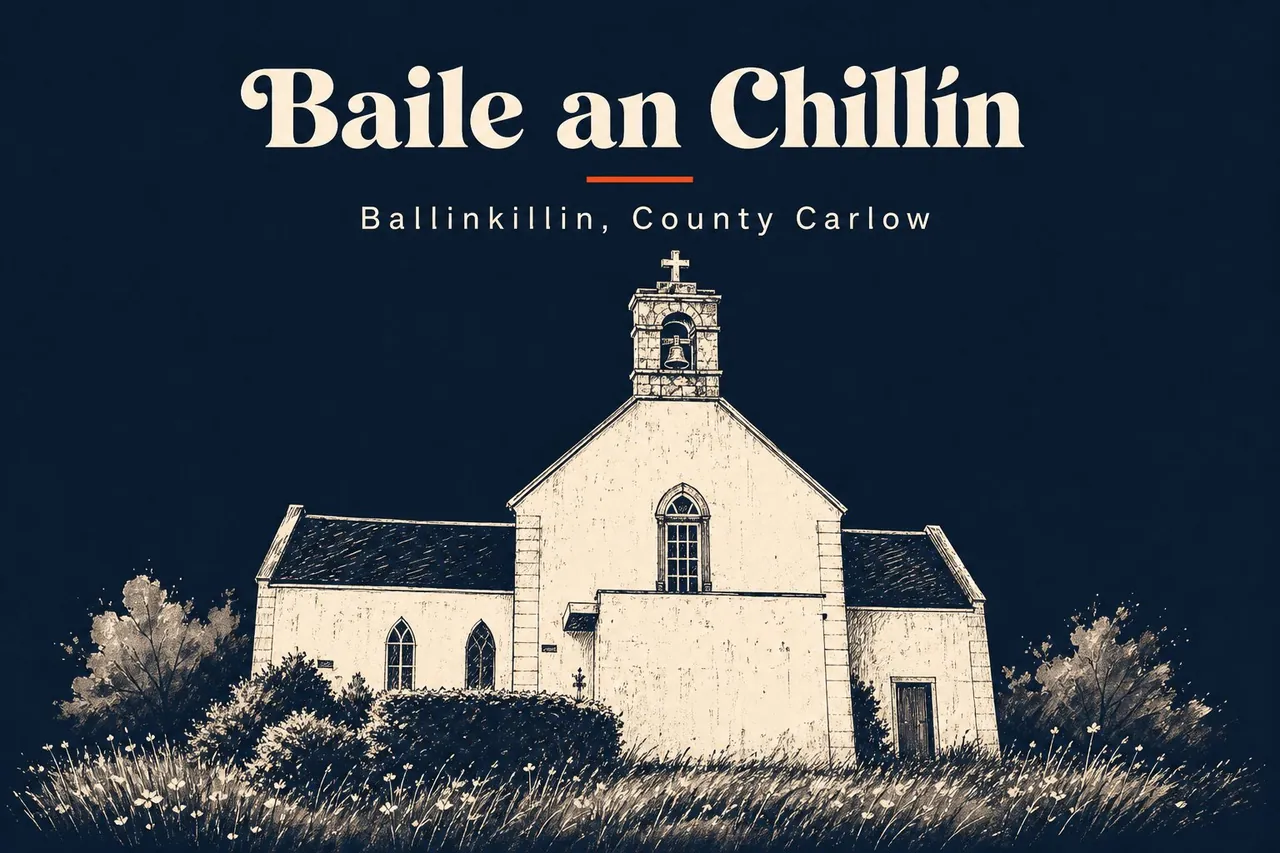
Baile an Chillín · Co. Carlow
Twenty houses between Bagenalstown and Borris, and a hurling team older than most of them.
Ballinkillin is twenty houses on a back road in south Carlow, dropped between Bagenalstown six miles north and Borris four miles south, with the river Barrow running its slow business in the valley to the east and Mount Leinster looming over the parish to the south-west. Drive through it and you'll miss it. Walk through it and there's a school, a church, a community centre, a hurling pitch, and a Lourdes grotto built out of local granite. That's the village.
What it has, it has properly. St. Lazerian's Church was built in 1793 by Fr. Michael Brophy and is one of the oldest in the diocese of Kildare and Leighlin - five stained-glass windows, a chapel yard consecrated by Bishop Doyle in September 1821, and a Calvary added in 1935 when granite was the answer to most things. The school next door has been teaching since 1810. The cardinal Patrick Francis Moran, who ended his career as Archbishop of Sydney, was raised in this parish and put up a high cross in the churchyard for his parents before he sailed.
The hurling is the heartbeat. Ballinkillin GAA was founded in 1890, when most of rural Ireland was still working out what the game even was, and McDonnell Park went through a major rebuild in 1992 that the parish paid for itself, eighty thousand pounds at the time. The senior county titles in 1973 and 2001 are the dates people give you in the post office. There's a 1798 heroine, Theresa Malone, buried locally, with a plaque the parish put up for the bicentenary in 1998. Every village this size has its dates. Ballinkillin keeps better track than most.