County Carlow Ireland · Co. Carlow · Nurney Save · Share
POSTED FROM
NURNEY
CO. CARLOW · IE

Nurney
An Urnaí

The Ireland's Ancient East
STOP 06 / 06
An Urnaí · Co. Carlow

A 5th-century monastery, one high cross, and a football club that punches well above its postcode.

Nurney is a small Carlow parish village sitting in the gently rolling farmland between Bagenalstown and Borris — ten minutes from either, an hour and change from Dublin, and easy to miss if you are not looking for the brown heritage sign. The road in is the R418, the landscape is hedgerows and cattle, and the village centre is a crossroads with a church and a pub. None of that is why it matters.

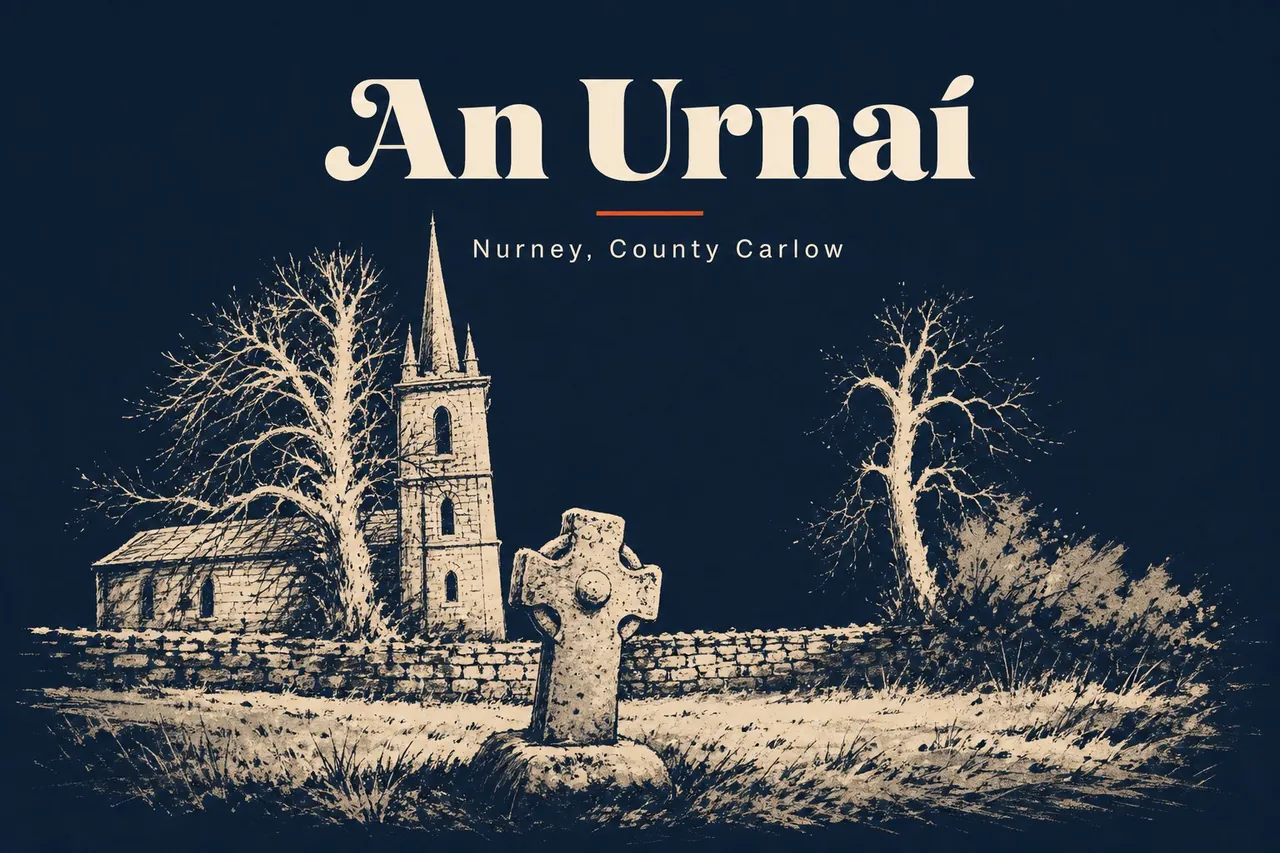
What matters is the Nurney Cross. It stands in a graveyard off a quiet lane — granite, two and a half feet across the arms, solid-wheeled in the early Irish style, set in a pyramid-shaped base and ringed by a low metal fence. It is a National Monument. The archaeological work on this site found evidence of St Abdán's monastic settlement from the 5th century, expanded through the 6th and 7th centuries, with the cross itself carved in the 8th. That puts it among the earliest high crosses in Ireland. It is not the most famous — Monasterboice and Clonmacnoise get the coaches — but it is the real thing, and you can stand in front of it alone on a Tuesday morning without buying a ticket.

The Church of Ireland building beside it — St John's, a listed Georgian structure from the 1780s — was put up by Colonel John Bruen MP, the local landlord, who also built a schoolhouse for £400, which was serious money at the time. The two buildings sit a few hundred metres apart: an 8th-century cross and an 18th-century church, fifteen centuries between them, both still standing. That is a longer conversation about Irish history than most heritage trails manage.

The modern village runs on the football club and the farming calendar. Nurney Villa AFC was founded in 1976 and has built up to 250-odd playing members — a number that strains credulity for a village this small, but the club draws from a wide hinterland and takes junior development seriously. The Carlow Premier Division is their regular competition; Leinster victories have happened. It is the kind of sporting success that a small place holds onto, because it is theirs and they made it.
Walk score
Cross to church in five minutes
Founded
St Abdán's monastery, 5th century
Coords
52.6270° N, 6.9980° W
01 / 06

At a glance.

Three things every local will eventually mention. Read these and you've already understood more than most day-trippers do.

02 / 06

The pubs.

None of these are themed Irish pubs, because they don't need to be. A few that earn the trip:

The Nurney Inn

Local, unhurried
Village pub

The community pub. Beer garden for the summer, the bar for the rest of the year. This is the place where the after-match debrief happens and the farming week gets discussed. 1-3 High Street.

03 / 06

Stories & lore.

The reason to come back. The things every local will eventually tell you about, usually after the second pint.

5th century — one of Ireland's earliest

St Abdán and the monastery

St Abdán founded his monastery here in the 5th century, when Irish monasticism was still finding its shape. Archaeological surveys have confirmed the original rectangular church and four round support buildings from that early period, with a further seven round buildings added in the 6th and 7th centuries as the community grew. By the 8th century, the site was large enough to support two churches and the carving of the high cross that still stands. The name that stuck — An Urnaí, the prayer — captures what this ground has been used for since long before the Norman word 'village' existed in Ireland.

National Monument, 8th century

The Nurney Cross

The cross is 1.88 metres tall with a 1.1-metre arm span — a solid-wheeled design with raised decorative bosses cut into the granite face. That solid wheel is a mark of early Irish cross-making, before the ring-headed ringed cross became standard. It sits on a pyramid-shaped base in a graveyard where the farmland comes right up to the wall. There is a low metal fence around it, which is as much protection as a National Monument in a quiet Carlow parish gets. Come in the morning when the light is low and the field behind it is still.

1780s — £400 for a school, which meant something

Colonel Bruen and the schoolhouse

Colonel John Bruen MP, the local landlord, built St John's Church and the schoolhouse in the 1780s. Spending £400 on a school in a rural parish at that time was not a routine act — it was a statement about the community he was trying to build. The church is a listed Georgian structure and still stands in good order. The schoolhouse beside it has had other lives since. Bruen was a Church of Ireland landlord building infrastructure for a largely Catholic parish — the cross that preceded him by a thousand years was already there.

04 / 06

When to go.

There is no bad time. There are different times.

Spring
Mar–May

The fields around the cross are at their greenest and the light on the granite is good. Quiet roads, no crowds.

◉ Go
Summer
Jun–Aug

A calm summer village. Football matches on weekends. The cross doesn't have a high season.

◉ Go
Autumn
Sep–Oct

Low slanting light makes the carved bosses on the cross stand out. Best time for photographs.

◉ Go
Winter
Nov–Feb

Not much on. The pub is open; the cross is there regardless. A short stop rather than a full afternoon.

◐ Mind yourself
05 / 06

What to skip.

Honestly? Don't bother.

If a local was sitting beside you, this is the bit where they'd lean in.

×
Expecting a visitor trail or heritage centre

There isn't one. The cross is in a graveyard, the church is a church, and that is the heritage offer. Bring your own context or read up beforehand.

×
Confusing this with Nurney in Kildare

Different village, different county, different everything. The Kildare one is near Curragh Camp. This one is in south Carlow. Google will autocomplete the wrong one if you are not precise.

+

Getting there.

By car

Bagenalstown is 10 minutes north on the R418. Carlow town is about 15 minutes. Dublin is 1h 40m via the M9 to Carlow. There is no through-route that accidentally passes Nurney — you are coming here on purpose.

By bus

Bus Éireann services connect Carlow town and Bagenalstown; Nurney itself has no direct scheduled service. A car or taxi from Bagenalstown is the practical option.

By train

Bagenalstown (Muine Bheag) is on the Dublin–Waterford line and is the nearest station, about 10 minutes by road. Then taxi.