County Carlow Ireland · Co. Carlow · Old Leighlin Save · Share
POSTED FROM
OLD LEIGHLIN
CO. CARLOW · IE

Old Leighlin
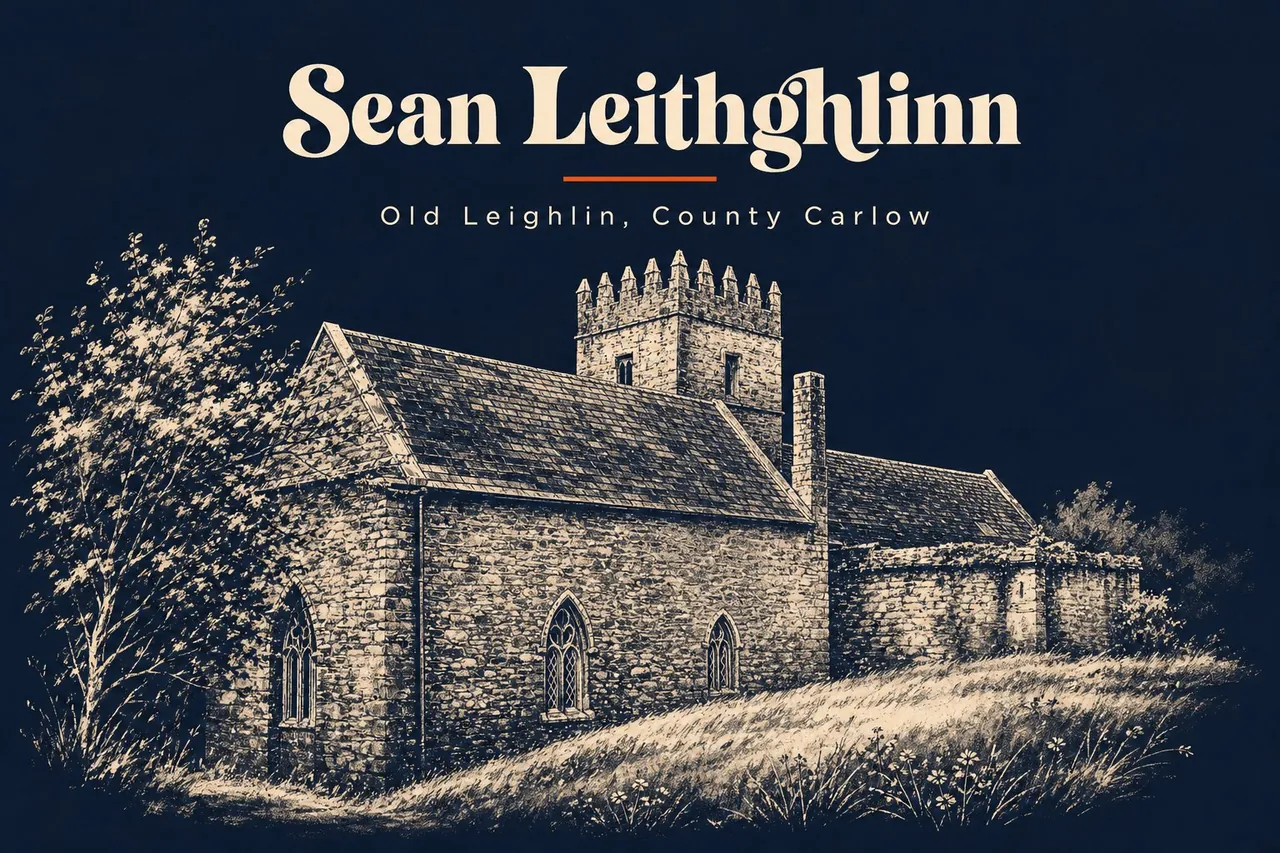
Sean Leithghlinn

The Ireland's Ancient East
STOP 06 / 06
Sean Leithghlinn · Co. Carlow

One cathedral, one holy well, one diocese born here fourteen centuries ago.

St Laserian — Molaise to those who knew him — came to this hillside above the Barrow around 630 AD and built a monastery. The site he chose was not accidental: a rise in the land, water close, defendable, open to the south. He died here in 639. The monastery survived him, barely, through Viking raids and Norman reorganisation, and the cathedral that stands in his place today is partly 12th century, partly older memory in stone.

In 1111, the Synod of Rathbreasail remade the Irish Church. The bishops and abbots who gathered that year divided the island into 24 dioceses — and Old Leighlin got one of them. The Diocese of Leighlin was born at that meeting, with this small hill as its seat. The town of Leighlin Bridge came later, three kilometres east. The diocese eventually merged with Ferns in 1600. But the cathedral stayed, and the Church of Ireland still holds it, and the stone still holds the date.

Come on a weekday and you may have the place entirely to yourself. The cathedral is locked outside of services — call ahead or try the keyholder listed on the notice board. The graveyard is always open, and the medieval carved slabs are worth the walk around the back wall. Tobar Molaoise, the holy well a short distance from the church, still draws a pattern day in late July or early August — one of the quieter surviving pattern days in Leinster, no crowds, no signage, just people who know the date. The village has no shop, no pub, no café. That is not an oversight.
Population
~100
Founded
c. 630 AD
Coords
52.6560° N, 6.9820° W
01 / 06

At a glance.

Three things every local will eventually mention. Read these and you've already understood more than most day-trippers do.

02 / 06

Stories & lore.

The reason to come back. The things every local will eventually tell you about, usually after the second pint.

The monk who chose this hill

St Laserian

Laserian — also written as Laisrén, known in devotion as Molaise — was a 7th-century monk who trained partly in Rome and returned to Ireland with a reputation for learning and severity. He founded his monastery on the Old Leighlin hillside around 630 AD, and the settlement that grew around it became a centre of some importance in the early Irish church. He died in 639 AD, and his feast day is 18 April. The well that bears his name still carries water.

The meeting that made a diocese

The Synod of Rathbreasail

In 1111 AD, the most consequential gathering in the medieval Irish church met at Rathbreasail — the precise location is debated, but the outcome is not. The bishops carved Ireland into 24 territorial dioceses on the Roman model, replacing the older monastic network. Old Leighlin was named the seat of one of those 24: the Diocese of Leighlin. The decision put this hillside on the ecclesiastical map of all of Leinster, and the cathedral built here in the 12th century is the physical consequence of that vote.

The pattern day that almost nobody knows about

Tobar Molaoise

Holy wells in Ireland once had pattern days — fixed annual days of prayer, walking the rounds, and gathering around the water. Most pattern days died out in the 19th century under church pressure or simple neglect. Tobar Molaoise, the well dedicated to St Laserian at Old Leighlin, still holds one. It falls on the last Sunday of July or the first Sunday of August. There is no signpost directing you to it from the main road. The people who come already know.

Medieval stone, still in the open air

The carved slabs

The graveyard around the cathedral holds a collection of medieval carved stone slabs — grave markers and tomb fragments bearing crosses, effigies, and lettering worn to near-illegibility by seven centuries of Carlow weather. They have not been moved indoors, resin-coated, or roped off. Walk the graveyard in low afternoon light when the shadows read the carvings for you. Some date to the 12th and 13th centuries. None of them have a QR code.

03 / 06

Things to do outside.

Wear waterproofs. Bring a sandwich. Tell someone where you're going if it's the mountain.

Cathedral and graveyard circuit Walk the perimeter of the cathedral, into the graveyard, and around the boundary wall to find the medieval slabs. Slow down at the east end of the church where the stonework is oldest. There is no formal trail — follow the grass path and use your eyes.
0.5 kmdistance
30–45 mintime
Old Leighlin to Leighlinbridge along the Barrow The road east to Leighlinbridge runs roughly parallel to the River Barrow. It is a quiet road — cattle gates, hedgerows, the occasional tractor. Leighlinbridge has the Black Castle ruin at the river crossing and a pub if you need one. Walk back or arrange a lift.
3 km one waydistance
45 mintime
04 / 06

When to go.

There is no bad time. There are different times.

Spring
Mar–May

The cathedral grounds are at their best in spring — the old yews and the graveyard grass, morning light on the south wall. Quiet and entirely your own.

◉ Go
Summer
Jun–Aug

Late July or early August catches the pattern day at Tobar Molaoise — the one day of the year the village has any collective movement. Worth timing.

◉ Go
Autumn
Sep–Oct

Good light for reading stone carvings. The site is always quiet; autumn makes the quiet feel earned.

◉ Go
Winter
Nov–Feb

The cathedral is rarely open in winter without advance arrangement. The graveyard is accessible but the days are short. Call ahead.

◐ Mind yourself
05 / 06

What to skip.

Honestly? Don't bother.

If a local was sitting beside you, this is the bit where they'd lean in.

×
Arriving without checking the cathedral is open

St Laserian's is a Church of Ireland cathedral with limited opening hours and no permanent staff on site. The building is locked outside of services and arranged visits. The graveyard is always open; the interior is not. Check the diocesan website or the notice board for keyholder contact details before making the trip the main event.

×
Expecting a café or a pub

There is no commercial infrastructure in Old Leighlin. No café, no pub, no shop. Leighlinbridge is 3km east and has both. Bagenalstown is 8km and has more. Plan accordingly.

×
Confusing this with Leighlinbridge

Leighlinbridge is the town on the Barrow with the castle, the bridge, and the services. Old Leighlin is 3km west: smaller, quieter, and the historically older site. The two are often mentioned together. They are not the same place.

+

Getting there.

By car

Old Leighlin is on the R448, 3km west of Leighlinbridge and 16km from Carlow town. From Carlow, take the R448 south through Leighlinbridge and continue west. The cathedral is visible on the right as you enter the village. No public car park — the road widens near the church gate.

By bus

No bus stops in Old Leighlin. Bus Éireann routes serve Leighlinbridge (Carlow–Kilkenny corridor); from there it is a 3km walk or a taxi.

By train

Bagenalstown (Muine Bheag) is the nearest station, 8km south, on the Dublin Heuston–Waterford line. Taxi or bike from there.