County Cork Ireland · Co. Cork · Conna Save · Share
POSTED FROM
CONNA
CO. CORK · IE

Conna
Conaithe, Co. Cork

The Ireland's Ancient East
STOP 07 / 07
Conaithe · Co. Cork

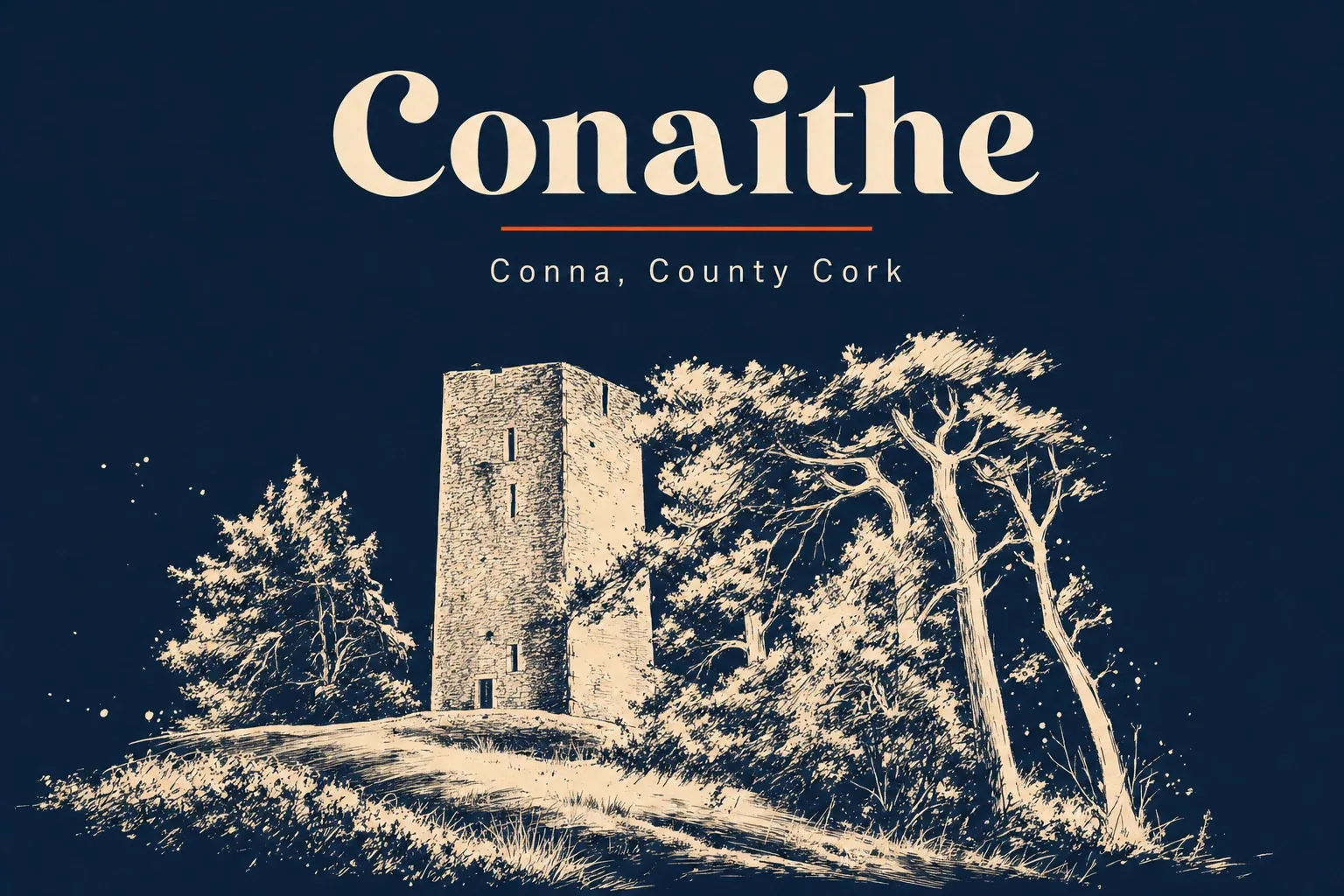
A five-storey Desmond tower house on a limestone bluff, a quiet bend of the Bride, and the East Cork village where Angela Lansbury once kept a farm.

Conna is a small village in East Cork, set on the River Bride where it cuts through farming country between Fermoy and the Waterford line. The Bride is a tributary of the Blackwater, and the whole valley is quiet, green and given over to dairy. Six hundred-odd people live here. There is a shop, a post office, a couple of pubs, a Catholic church from around 1820, a Church of Ireland chapel, and a national school with about 160 children. That is the working village, and it is enough to keep itself going.

The reason you stop is the castle. Conna Castle is a five-storey tower house built around 1560 for Sir Thomas Ruadh FitzGerald, perched on a steep limestone bluff right over the river. It is the kind of late-medieval structure that actually stands - vaulted first floor, ogee windows on the upper storeys, mural chambers and a garderobe cut into the wall. You cannot go inside; it is an unguided State site and access is external only. But the rock it sits on, and the drop to the Bride below, make the point on their own.

Beyond the castle and the river, Conna offers what it is. There is no restaurant of note, no hotel. Fermoy is about fifteen minutes north for a bed, a meal or a train of thought; Tallow is six miles east across the county line in Waterford; Youghal is south at the river mouth. Conna is a place you route through, look up at, and route on from. Treat it that way and it rewards you. Treat it as a destination with a day's worth of amenities and it will let you down, because it never promised that.
Population
609 (2022)
Founded
Tower house built c. 1560 for Sir Thomas Ruadh FitzGerald
Coords
52.0928° N, 8.1100° W
01 / 07

At a glance.

Three things every local will eventually mention. Read these and you've already understood more than most day-trippers do.

02 / 07

The pubs.

None of these are themed Irish pubs, because they don't need to be. A few that earn the trip:

Village pubs

Rural locals
Two or three small local bars

Conna has a couple of pubs serving the village and the surrounding farms - the kind of small rural bars that keep their own hours and fill up around a match or a funeral rather than for passing trade. Research does not pin down current names and opening times reliably, so ask in the shop, or do your proper drinking and eating fifteen minutes up the road in Fermoy.

03 / 07

Stories & lore.

The reason to come back. The things every local will eventually tell you about, usually after the second pint.

FitzGerald, c. 1560

The Desmond tower house

Conna Castle was built around 1560 for Sir Thomas Ruadh FitzGerald, son of James FitzThomas FitzGerald, the so-called Súgán Earl of Desmond. It is a five-storey tower house on a limestone outcrop above the Bride: a vaulted first floor built over wickerwork centring, slit windows at ground level, ogee-headed windows higher up, and small mural rooms within the wall thickness. Thomas Ruadh died there in 1595. Richard Boyle, the Earl of Cork, repaired the castle in 1620. In the Confederate Wars it was taken by James Tuchet in 1645. The structure you climb up to today is largely that 16th-century shell - roofless, but standing.

The castle changes hands the hard way

Raleigh, Cromwell and the 1653 fire

Like much of the Desmond estate, Conna passed into English hands after the Desmond rebellions, and the lands around it were part of the vast grant given to Sir Walter Raleigh. Local tradition holds that Oliver Cromwell passed by and put a cannon shot or two at the walls before moving on. The grimmer fact is the fire of 1653, when the castle burned and three daughters of the steward, Edward Germaine, were killed in it. Hilary L'Estrange bought the castle in 1851; on the death of his son, the Rev. A. G. K. L'Estrange, in 1915, it became the first tower house of its type to be willed to the care of the State.

Knockmourne Glebe, from 1970

Angela Lansbury kept a farm here

The actor Angela Lansbury moved to East Cork in 1970, after a fire destroyed her Malibu home and she wanted her teenage children away from the California drug scene. The family settled at Knockmourne Glebe, a farmhouse in the townland of Curraheen just outside Conna, and she would cycle into the village. She later moved on to Ballywilliam, and went on to play Jessica Fletcher in Murder, She Wrote for twelve years, but Conna was the sanctuary she chose first. She died in 2022 at ninety-six. The locals still claim her.

04 / 07

Things to do outside.

Wear waterproofs. Bring a sandwich. Tell someone where you're going if it's the mountain.

Conna Castle and the river bluff Walk up to the tower house on its limestone rock above the Bride. Access to the site is external only - you view the castle from outside, not within - and the ground is steep and unguided, so wear boots and mind the drop. The view down to the river bend is the reason to make the climb.
Short, on foot from the villagedistance
30-45 minutestime
River Bride lanes The minor roads along the Bride valley out toward Curraheen, Clashaganniv and Kilclare run through proper farming country, with ringforts, a standing stone and fulacht fiadh sites scattered through the townlands if you know what you are looking at. Quiet, narrow, and shared with tractors. Good for a slow wander rather than a marked trail.
As far as you likedistance
An hour or twotime
05 / 07

When to go.

There is no bad time. There are different times.

Spring
Mar-May

The Bride valley greens up and the light is kind on the castle rock. Dry-ish ground for the climb to the tower house. Quiet on the roads.

◉ Go
Summer
Jun-Aug

Long evenings and the best chance of dry footing up to the castle. Still a working farming village rather than a tourist one, so do not expect crowds or extra services.

◉ Go
Autumn
Sep-Oct

Soft light, low river, harvest in the fields around. A good time to combine Conna with Lismore or Tallow across the Waterford line.

◉ Go
Winter
Nov-Feb

Short days and a steep, muddy, unguided climb to the castle. The village keeps going but there is little shelter and less reason to linger.

◐ Mind yourself
06 / 07

What to skip.

Honestly? Don't bother.

If a local was sitting beside you, this is the bit where they'd lean in.

×
Expecting to get inside the castle

Conna Castle is an unguided State monument and access is external only. You can walk up to it and around it, but the tower is not open and there is no interior tour. The drama is the bluff and the silhouette, not a guided room-by-room.

×
Treating Conna as a base

There is no hotel and no restaurant of note in the village. For a bed, a proper meal or a train, you want Fermoy fifteen minutes north or Youghal on the coast. Conna is a half-hour stop, not a day's worth of amenities.

+

Getting there.

By car

Conna sits on the R628, southeast of Fermoy and about six miles west of Tallow, Co. Waterford. Fermoy (around 15 min north) and Youghal (south, near the coast) are your anchors for fuel, food and beds.

By bus

There is no frequent public service through the village; rural East Cork is covered patchily by Local Link. Realistically you arrive by car. Fermoy, on the N8/M8, is the nearest town with regular Bus Éireann connections.

By train

No railway. The nearest mainline stations are at Mallow and Charleville on the Dublin-Cork line, both a fair drive away. Plan to drive.