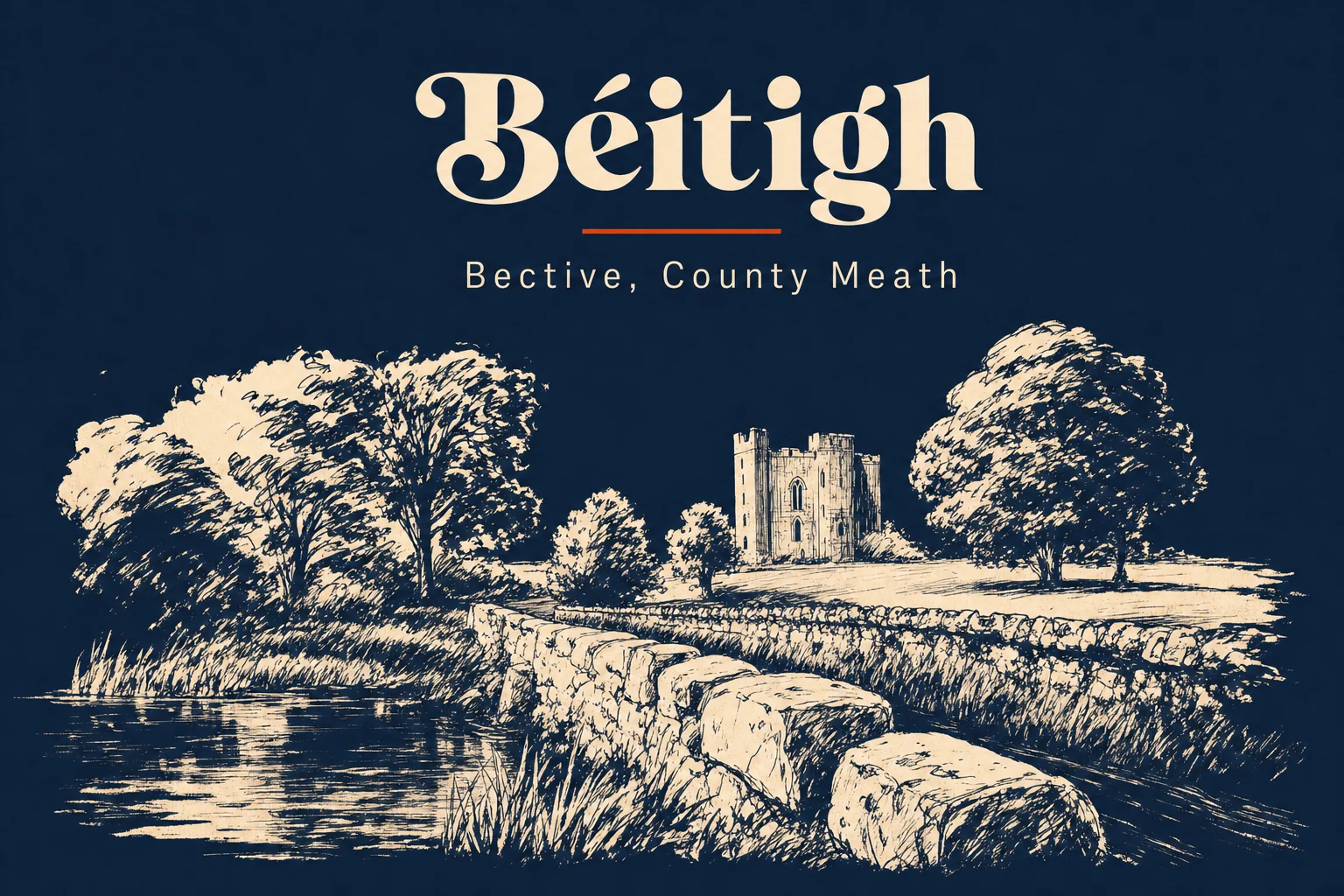
Béitigh · Co. Meath
A few houses, a bridge, and the second Cistercian abbey ever built in Ireland - sitting in a field by the Boyne, free to walk into.
Bective is the abbey and the Boyne, and not much else - and that is exactly the point. It sits on the left bank of the river about six kilometres east of Trim, on the old Athboy to Dunshaughlin road, in country that has forgotten how to be loud. Around 374 people live in the wider townland. There is a bridge, a Church of Ireland parish church from the 1850s, a stud farm, and the ruins. That is the village.
The abbey is the reason to come. Founded in 1147 by Murchad O Maeil-Sheachlainn, King of Meath, as a daughter house of Mellifont down in Louth, it was the second Cistercian foundation in Ireland. Unlike most Cistercian houses, which went looking for wilderness, Bective planted itself on fertile Boyne land and grew rich on it. What stands now - the early 13th-century church, the 15th-century cloister with its pointed arches, the squat 16th-century tower - is reckoned the best-preserved Cistercian cloister range in the country. The Office of Public Works bought the site in 2012. It is a National Monument and it is free to walk into.
The other name worth knowing here is Mary Lavin. Her father came back from Boston to manage the Bective estate, the family bought Abbey Farm overlooking the ruins, and in 1942 she published Tales from Bective Bridge, the short-story collection that made her name and won the James Tait Black Prize. She wrote rural Meath as it actually was. The bridge in the title is the one you cross to reach the abbey.
Do not arrive expecting a tea shop on every corner. There is no pub in Bective itself - for that you walk the kilometre to Kilmessan. What there is, is a roofless Cistercian church in a green field by a slow river, usually empty, with a car park and a gate and nobody to take your money. Bring a flask. The Boyne moves past like a thought.