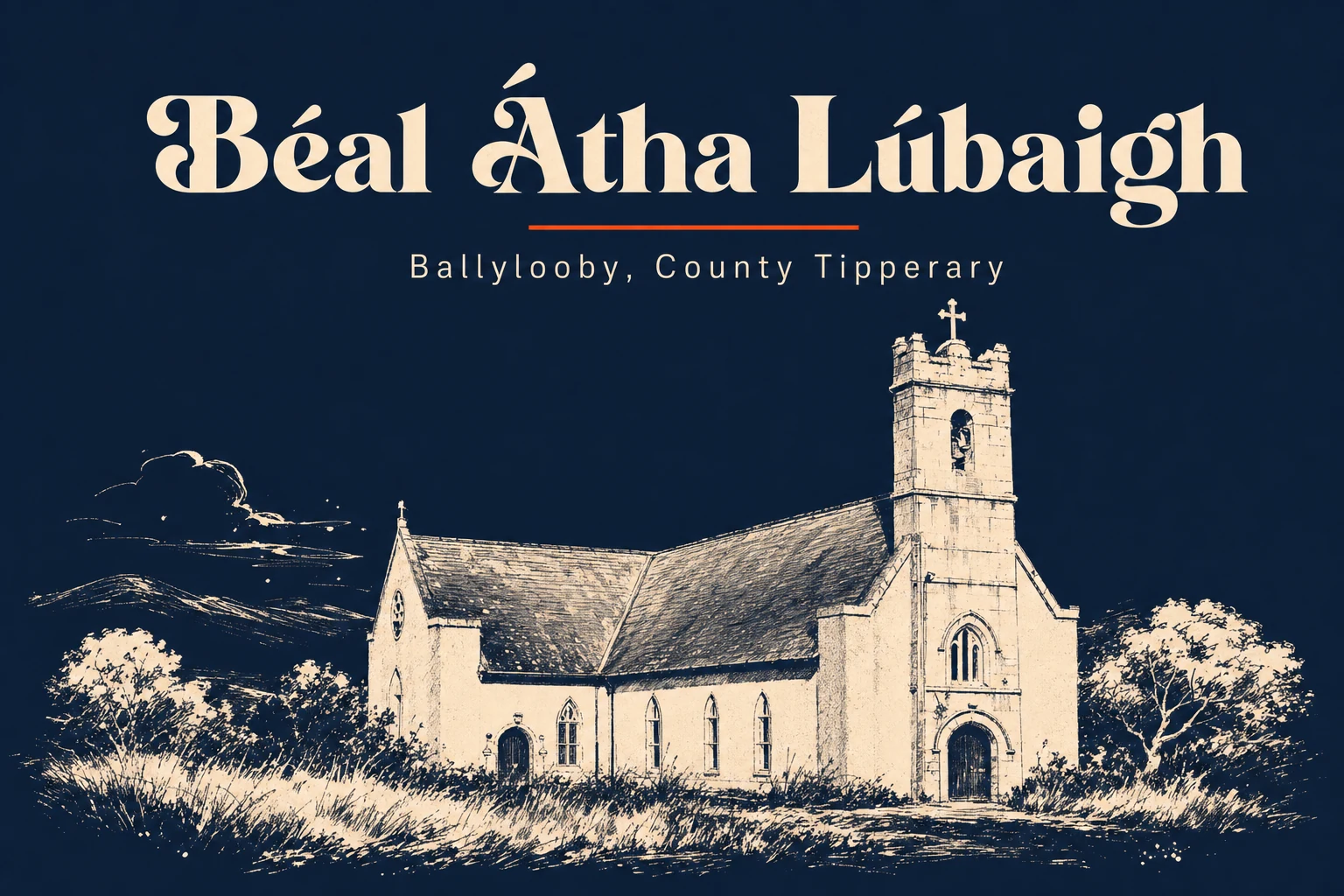
Béal Átha Lúbaigh · Co. Tipperary
Seven kilometres from Cahir, halfway to the Vee, easy to miss and worth not missing.
Ballylooby is easy to describe: a small village on the R668 between Cahir and Clogheen, roughly seven kilometres south of Cahir, midway between a castle town and a mountain. In 1889 Bassett's Directory recorded it as fourteen houses. It hasn't grown much. The Irish name - Béal Átha Lúbaigh - means the mouth of Looby's Ford, which places its origin at a river crossing that was here long before the road.
What stops you here, if anything does, is the Church of Our Lady and St. Kieran, a plain limestone building put up in 1813 and extended in 1927 by the Dublin architect Rudolf Maximilian Butler. The interior has a hammer-beam roof and an ornate marble reredos - more than the exterior suggests. The land deal to build it went badly: a Patrick Burke sold the extra ground required, then changed his mind, erected a wall inside the building and sued the parishioners for trespass. The case ran for years and was eventually settled in their favour. The wall is gone. The church remains, sitting in a fold of the south Tipperary land that the Knockmealdowns close off to the south.
The village is best understood as a place people came from rather than a place people came to. One of those people was Michael Tierney, born here in September 1839, who emigrated, was ordained a priest, and in 1894 was appointed the sixth Bishop of Hartford, Connecticut, by Pope Leo XIII. During his fourteen years in the diocese he founded St Thomas Seminary, five hospitals, and dozens of charitable institutions. Another was Tommy Ryan, who played football and hurling for Ballylooby-Castlegrace and was on the Tipperary team in Croke Park on the morning of 21 November 1920 - Bloody Sunday - when the Black and Tans fired into the crowd. Ryan was knocked to the ground, stripped, and held at gunpoint before an officer intervened and had the remaining players released. He survived. Most of them did. Fourteen in the crowd did not.