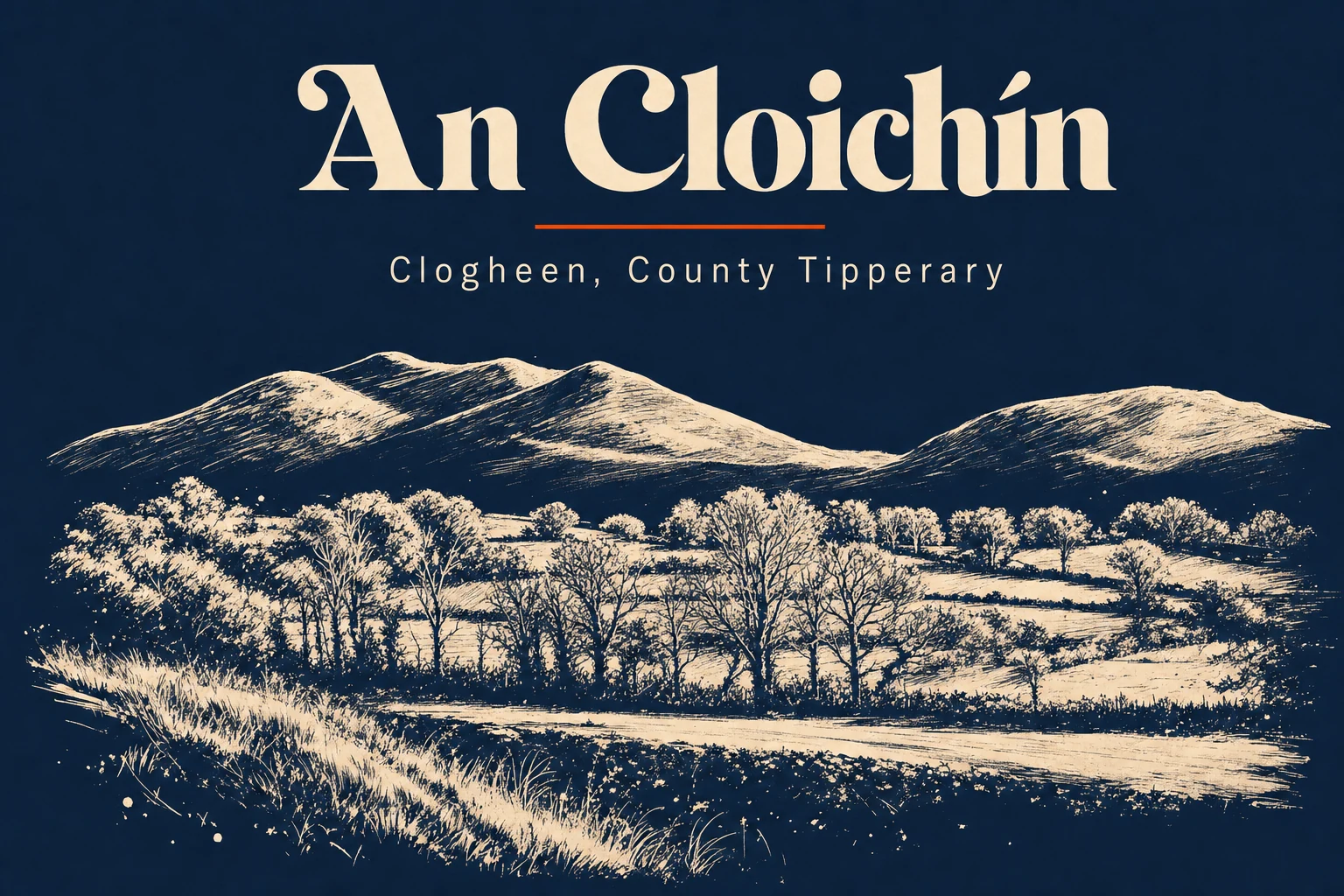
An Cloichín · Co. Tipperary
The last village before the road tries to climb out of Tipperary.
Clogheen is a small village on the R668 at the foot of the Knockmealdown Mountains, about twenty kilometres south of Cahir. It has a square, a church, a few houses in close order, and one excellent reason to stop: the Vee road begins here. Drive south out of the village and within two kilometres the fields give way to heather and gorse, the road narrows, and the mountain begins in earnest.
The Vee itself - a V-shaped gap in the Knockmealdowns at around 300 metres - is where the R668 bends sharply before descending into Lismore and the Blackwater valley of County Waterford. Bay Lough, a corrie lake formed in the last ice age, sits in the fold of the mountains just below the road. The Sugarloaf Hill ridge rises above it. The whole pass takes twenty minutes to drive and most people do exactly that. It is worth considerably more.
The other reason to know Clogheen is Shanrahan, the old graveyard a short distance from the village where Father Nicholas Sheehy is buried. Sheehy was a Catholic priest hanged in Clonmel in 1766, convicted of murder on what his community considered - and most historians since have agreed - to be fabricated evidence. The real charge was his suspected involvement with the Whiteboys, the agrarian secret society that was terrorising landlords across Munster in the 1760s. His severed head was displayed on Clonmel gaol; his body was brought back to Shanrahan. People still visit. The grave is plain and the surrounding countryside is very quiet.
This is not a village that trades on its attractions. There is no heritage centre, no coach park, no audio trail. What there is: a road over a mountain that repays a slow morning, a graveyard that puts eighteenth-century Irish history in front of you without a screen, and a lake with a ghost story the locals have been telling since before the road existed. That is quite enough.