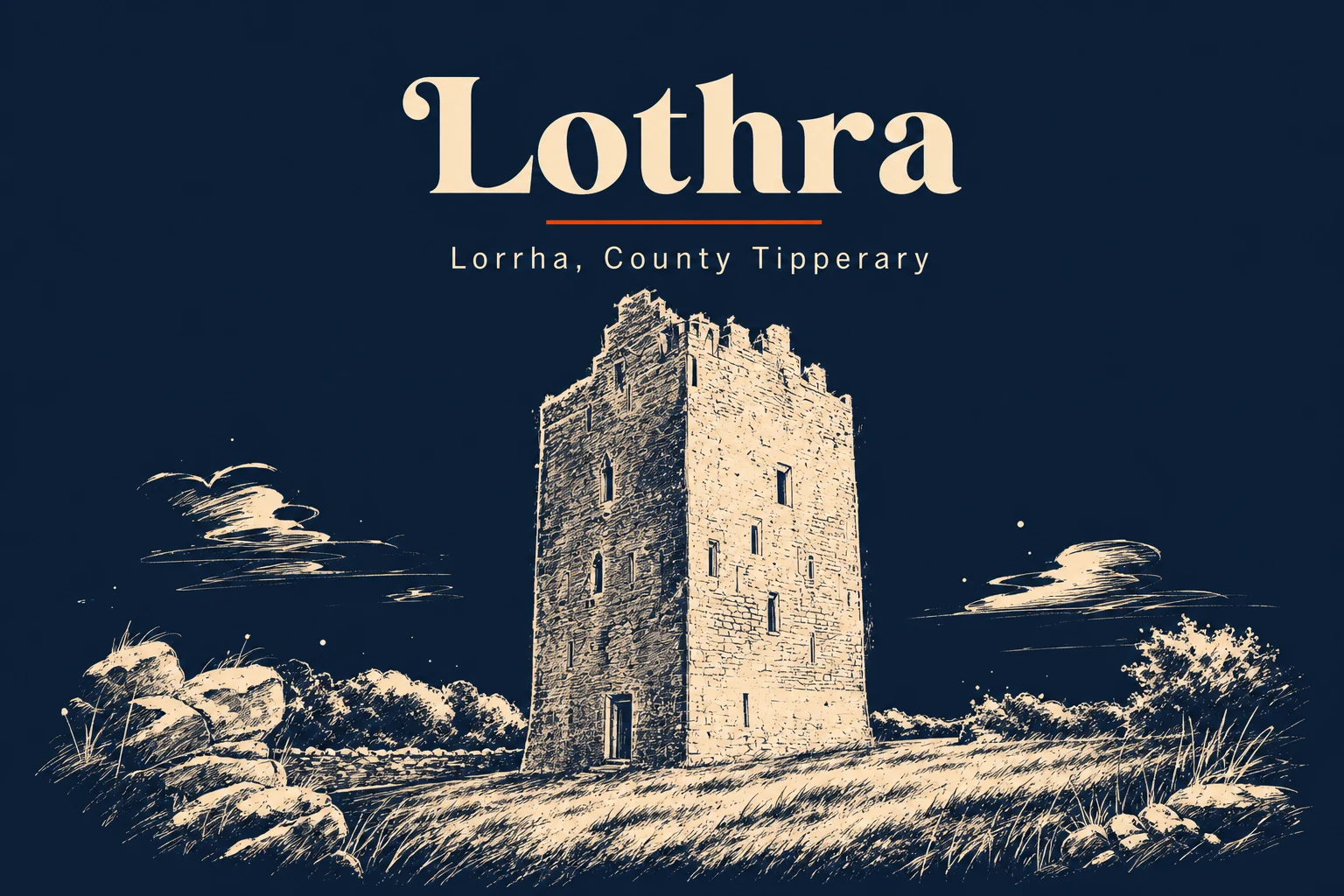
Lothra · Co. Tipperary
The saint cursed Tara. His village kept a thousand-year-old Mass book.
Lorrha sits in the far north of Tipperary, a few kilometres from Lough Derg and closer to the Galway border than to Nenagh. Two hundred people, a monastic ruin, a medieval priory, and a reputation in early Irish Christianity completely out of proportion to any of that. The village has been here for fifteen hundred years. It shows.
St Ruadhán founded his monastery around 550 AD. He was one of the Twelve Apostles of Ireland - the early monastic figures trained under St Finnian of Clonard - and in his own time was apparently significant enough to travel to Tara and spend weeks cursing the High King Diarmait mac Cerbaill from the gates. The tradition says the curse worked: Tara went quiet and the high kings stopped meeting there. Historians debate how literally to take all of this. The monks of Lorrha were in no doubt.
The Stowe Missal surfaced at Lorrha in the 18th century - a small liturgical book written around 792 AD, containing an early form of the Irish Mass along with other devotional texts. It had survived inside a cumdach, a decorated metal book shrine, commissioned around 1025 AD. The manuscript went to the Royal Irish Academy. The shrine went to the National Museum of Ireland. Both are still there. The village they came from has a ruined church and a handful of old graves.
None of this makes Lorrha a day-trip destination in any conventional sense. There is no heritage centre, no café, no car park with an interpretive panel. What there is: real medieval ruins, a GAA club that produced an All-Ireland hurler, Lough Derg ten minutes west, and the sense that the ground here has been holding its history quietly for a very long time.