County Wicklow Ireland · Co. Wicklow · Baltinglass Save · Share
POSTED FROM
BALTINGLASS
CO. WICKLOW · IE

Baltinglass
Bealach Conglais, Co. Wicklow

The Ireland's Ancient East
STOP 09 / 09
Bealach Conglais · Co. Wicklow

A working west Wicklow market town with a 12th-century Cistercian abbey in the middle of it and Lugnaquilla - the highest mountain in Leinster - visible on a clear day to the east.

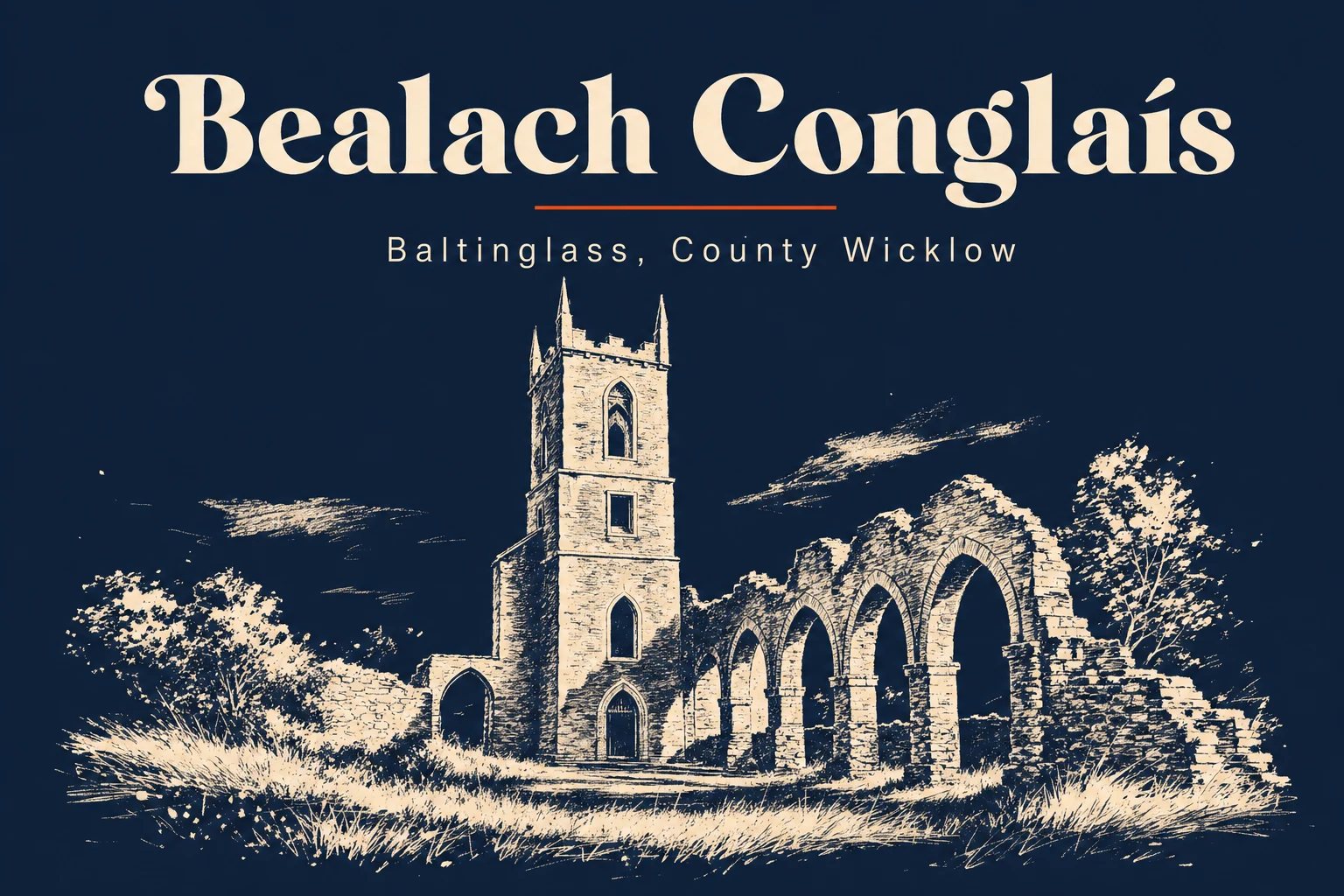
Baltinglass doesn't sell itself particularly hard. It's a market town of about 2,600 people in the far west of Wicklow, on the River Slaney, where the county starts to flatten out toward Kildare. The abbey ruins sit on the north edge of the town centre - a 12th-century Cistercian church with six Gothic arches still standing, founded in 1148 by Diarmait Mac Murchada in the last years before he did the thing he is remembered for. It is freely accessible, unguarded, and usually empty. That's the kind of place Baltinglass is.

The Slaney runs through the middle of town. It started life on the slopes of Lugnaquilla, the highest mountain in Leinster at 925 metres, and by the time it reaches here it's a proper river - wide enough to look at, not big enough to look threatening. Lugnaquilla itself is visible on clear days to the northeast, and Baltinglass Hill - the one closer to town, topped with a Neolithic passage tomb that dates to around 3600 BC - sits two kilometres to the east. You can walk to the top in an hour and look out over most of south Leinster.

The town has pubs, a handful of places to eat, and the kind of general business that keeps a market town going. If you're here because someone recommended the abbey or the hill walk, good - they were right. If you're looking for something that's been turned into a tourism product, you've come to the wrong place, which is, in the end, the right place.

Population
2,611 (Census 2022)
Pubs
3and counting
Walk score
Baltinglass Hill 4 km return; Lugnaquilla via Glen of Imaal 13 km
Coords
52.9339° N, 6.7109° W
01 / 09

At a glance.

Three things every local will eventually mention. Read these and you've already understood more than most day-trippers do.

02 / 09

The pubs.

None of these are themed Irish pubs, because they don't need to be. A few that earn the trip:

Germaine's of Baltinglass

Traditional, food-led, families welcome
Bar, restaurant & guesthouse

On Main Street, Germaine's is the most complete pub in town - bar, full restaurant, function room, roof terrace, and rooms above. Food from morning until late, seven days. Carvery at lunch, a la carte in the evening, a Sunday afternoon club for families. The kind of place that serves the town rather than serving passing trade, which means the welcome is the real kind.

Horan's Bar

Local, straightforward, long-established
Pub with bar and accommodation

Dating to 1881 on the main street under family ownership. A traditional bar at its core, with rooms available and a function room that gets used by the town. The sort of pub that has been here longer than anyone alive remembers it not being here.

Baltinglass Inn (Timmins Bar)

Local bar, relaxed
Traditional pub

A straightforward bar in town with a beer garden and a private loft. Known locally as Timmins Bar. No frills is the right description - if you want a quiet pint in a room that hasn't been redesigned to attract tourists, this is it.

03 / 09

Where to eat.

PlaceTypeLocal note
Germaine's of Baltinglass Bar restaurant €€ The most reliable food option in Baltinglass. Carvery lunch with beef, pork and the usual choices; a la carte in the evenings. Family-friendly with a Sunday afternoon club for children. Not a destination restaurant in the fine-dining sense, but consistent, generous and locally run. Food served from 9am to 11pm, seven days.
Horan's Bar & Restaurant Bar food and restaurant €€ Food alongside the bar trade, evening meals. A working local restaurant rather than anything elaborate. Reliable if you're staying nearby and want dinner without getting back in the car.
04 / 09

Where to sleep.

PlaceTypeLocal note
Germaine's of Baltinglass Guesthouse rooms above the pub Rooms above the bar and restaurant on Main Street. The location is the advantage - abbey a short walk, town on your doorstep, breakfast built in. Not a hotel in the lobby-and-leisure-centre sense, but a proper guesthouse run by people who live in the building.
Horan's Bar & Accommodation Pub accommodation Rooms attached to the bar on Main Street, operating since 1881 under family ownership. A practical base for the abbey and the hill walks. The breakfast will be the full Irish kind and the bar is downstairs, which either helps or doesn't depending on how you look at it.
05 / 09

Stories & lore.

The reason to come back. The things every local will eventually tell you about, usually after the second pint.

Diarmait Mac Murchada built Baltinglass Abbey in 1148. He is better remembered for what he did twenty years later.

The man who founded the abbey and the Normans

Diarmait Mac Murchada, King of Leinster, founded Baltinglass Abbey for the Cistercians in 1148, shortly after the order established its first Irish house at Mellifont. Church reformers of the time regarded Diarmait as an ally - he built abbeys, he supported the reform movement. In 1166, a coalition of Irish kings expelled him from Leinster after a long-running dispute over his abduction of Dervorgilla, wife of Tiernan O'Rourke of Breifne. Diarmait crossed to Bristol and appealed to Henry II of England for military help. The Anglo-Norman mercenaries who landed in Ireland in 1169 at his invitation changed the country for the following eight hundred years. The ruins of the abbey he built before any of that stand on the north side of Baltinglass, freely accessible, without a visitor centre or an entry fee.

A Cistercian church built in 1148 that was still occupied in 1536.

What the abbey is, and what survives

The Cistercians were an austere order who built spare, functional architecture - no decoration for its own sake, no vanity stonework. Baltinglass Abbey's church is 56 metres long, with a nave, aisles, chancel, and a pair of transepts. The six Gothic arches on alternate round and square pillars are the feature most people remember. Some of the cloister to the south has been rebuilt. The east windows and tower are 19th-century additions. The abbey was occupied for nearly four hundred years before the Dissolution of the Monasteries in 1536 shut it down. It is today a National Monument, which means the OPW maintains it and anyone can walk in.

A Neolithic cairn older than Newgrange, two kilometres from town.

The passage tomb on Baltinglass Hill

Rathcoran, the passage tomb on the summit of Baltinglass Hill, was excavated in the 1930s and later subject to detailed radiocarbon dating that placed its construction at around 3600-3400 BC - roughly contemporaneous with Newgrange, possibly slightly earlier. The cairn is 27 metres in diameter and covers at least five separate structures. The main tomb has a three-metre passage with roof slabs still in place, leading to a chamber with three narrow compartments and a basin stone. The finds included the cremated remains of at least three adults and a child, flint scrapers, and carbonised wheat grains and hazelnuts sealed under the cairn. A double-rampart Iron Age hillfort - also called Rathcoran - was built around the cairn centuries later, using the Neolithic monument as its centre. The hill is two kilometres east of town and the walk to the summit takes about an hour.

06 / 09

Things to do outside.

Wear waterproofs. Bring a sandwich. Tell someone where you're going if it's the mountain.

Baltinglass Hill and the Rathcoran passage tomb From the town, the hill is clearly visible to the east. The path to the summit is a steady climb through farmland and open ground to the cairn and the Iron Age hillfort at the top. The views take in most of south Leinster: the Wicklow Mountains to the north and east, the Kildare plain to the west. The passage tomb's kerbed cairn and the remains of the tomb passage are visible at the top. Boots recommended - the ground is wet in winter and spring.
4 km returndistance
1.5-2 hourstime
Lugnaquilla via the Glen of Imaal The standard route up Lugnaquilla (925 m, highest in Leinster) starts from the Glen of Imaal, about 15 minutes northeast of Baltinglass. Park near Seskin - the trailhead is by the statue of United Irishman Michael Dwyer. The route climbs via Camarahill to Percy's Table, a broad peaty plateau below the summit, then up the final rock-strewn slope to the top. Important: the route passes through the Irish Army artillery range in the Glen of Imaal. Check the range closure schedule at military.ie before you go, and do not leave the approved path. Boots, waterproofs, and navigation skills required - the summit plateau gives no landmarks in poor visibility.
13 km returndistance
4-5 hourstime
07 / 09

When to go.

There is no bad time. There are different times.

Spring
Mar-May

The hill walk to Rathcoran is at its best in April and May before the ground dries out. The abbey ruins in morning light, before the few visitors arrive, are a good reason to be here rather than somewhere busier. The Slaney runs well after winter.

◉ Go
Summer
Jun-Aug

Baltinglass has no tourist season to speak of, so summer brings no crowds and no queue. The long evenings are the reward - daylight until ten, Lugnaquilla summit clear on a good day, the abbey warm in the late sun.

◉ Go
Autumn
Sep-Oct

The walking season extends well into October on Baltinglass Hill and the Lugnaquilla approaches. The bog changes colour, the light gets low and useful, and the town returns entirely to itself.

◉ Go
Winter
Nov-Feb

The abbey is fine in any weather - it's been rained on for 875 years. The hill walk is manageable in dry winter conditions. Lugnaquilla in winter is a mountain in winter: ice on Percy's Table, no visibility on bad days, and the army range may have different closure patterns. The town still has the pubs and the restaurant. That's enough.

◐ Mind yourself
08 / 09

What to skip.

Honestly? Don't bother.

If a local was sitting beside you, this is the bit where they'd lean in.

×
Driving past on the N81 without stopping

The N81 from Dublin to Carlow runs straight through Baltinglass and most people stay on it. The abbey is three minutes off the road and the majority of people who would have liked it don't know it's there.

×
Lugnaquilla without checking the military range schedule

The Glen of Imaal is an active Irish Army artillery range. The closure schedule is published at military.ie. Arriving at the trailhead on a closed day means turning around.

×
Expecting a village frozen in time

Baltinglass is a working town with a Lidl, a Centra, and the normal business of a market town. The abbey is extraordinary and the hill walk is real, but the town itself is not a period piece. That's fine. That's what it is.

+

Getting there.

By car

Dublin to Baltinglass is about 1 hour 15 minutes via the N81 southwest through Blessington and Hollywood. From Carlow town it's 30 minutes north. From Wicklow town, cross-country via Rathdrum, about 45 minutes. The town is well signed on the N81.

By bus

Bus Éireann route 105 runs between Dublin (Busáras) and Baltinglass via Tallaght, Blessington and Dunlavin. Services are not frequent and the last bus back to Dublin is not late. Check the Bus Éireann website for current timetables before you travel.