← All Belfast tours via partner · From €199 · 2 days 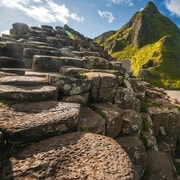
From Dublin: Belfast and Giant's Causeway: 2-Day Guided Tour
Free cancellation 48 traveller reviews Booked securely via partner
Check availability & prices →
From €199 per person
This two-day guided tour covers two of the island of Ireland’s most compelling destinations - Belfast and the Giant’s Causeway - with overnight accommodation in the city so you’re not rushing any of it.
Day 1: Dublin to Belfast
You depart Dublin and head north on the two-hour drive to Belfast via the new Peace Highway. The first stop is St Peter’s Cathedral in Drogheda, where you can see the fully preserved head of St Oliver Plunkett - beheaded by the English in 1681, his head is now kept in a glass case by the altar.
From Drogheda, the coach takes a short detour to the haunting ruins of Monasterboice. The 10th-century round tower here was a refuge from Viking raids, and the grounds contain some of the most beautiful Celtic crosses in Ireland - carved by hand by monks in the 9th century.
On arrival in Belfast you’ll have two hours of free time. The optional Black Taxi Tour of the Falls and Shankill Roads comes highly recommended - it’s the best way to understand the murals and the political history of those neighbourhoods. Or use the time for lunch and a wander around the city centre.
The afternoon is spent at Titanic Belfast, the city’s number one attraction. You’ll have two hours to follow the story from the ship’s design in Belfast in the early 1900s, through her construction and launch, to the infamous maiden voyage and the sinking. The exhibition is excellent.
Overnight in Belfast’s historic downtown university quarter.
Day 2: Belfast to Giant’s Causeway and back to Dublin
The second day heads up through the rolling farmland of County Antrim to the north Antrim coast. There’s a photo stop at the Carrick-a-Rede rope bridge, with views across to Rathlin Island, before continuing along the coast to the Giant’s Causeway.
The Causeway is one of those places that genuinely lives up to the hype. Around 40,000 interlocking basalt columns formed by volcanic activity 50 to 60 million years ago step down from the cliffs into the sea. Your guide is on hand to explain both the geology and the legend - the mythical story of the giant Finn McCool is part of what makes this place so engaging. You’ll have time to walk down to the stones and explore at your own pace before heading back to Dublin.
At Drogheda, you’re at St Peter’s for the shrine of St Oliver Plunkett - it’s free to enter and the queue moves quickly. If you have a few minutes before or after, Drogheda is worth a brief look at St Laurence’s Gate, the best-preserved medieval town gate in Ireland. It’s a two-minute walk from West Street and the kind of thing that stops people mid-stride.
At Monasterboice, Muiredach’s High Cross - with its carved biblical panels - is considered the finest Celtic cross in Ireland. Give it ten minutes up close rather than a quick photograph from the path. Both the round tower and the crosses are free and open. The site is compact and fits comfortably into a thirty-minute stop.
Overnight in Belfast: the Black Taxi Tour of the Falls and Shankill Roads that the tour recommends is the most honest way to understand the mural districts. Most drivers grew up on one side or the other and give you the story straight rather than tour-guide smooth. Book through your accommodation the evening you arrive. If you want a pint after the taxi tour, Kelly’s Cellars on Bank Street has been open since 1720 and the United Irishmen plotted the 1798 rising there - it’s a ten-minute walk from most of the university quarter hotels.
Day 2 timing: the Giant’s Causeway is at its quietest before 10am and after 4pm. If your group gets there early on Day 2, you’ll have the basalt columns largely to yourselves. The walk down from the visitor centre to the stones takes about fifteen minutes; allow an hour to explore at your own pace. The stones themselves are free - you don’t need to pay the visitor centre admission to walk on them.
At Bushmills: three kilometres from the Causeway, Bushmills is the natural base for Day 2. The Old Bushmills Distillery has been making whiskey on the same river since 1784 (the 1608 date on the bottle is the royal licence, not the buildings). The Giant’s Causeway and Bushmills Railway is a narrow-gauge heritage line that pootles two miles from the village to the stones - if you want to avoid driving to the visitor centre, walk from Bushmills along the railway path and take the train back.
Carrick-a-Rede and Ballycastle: the rope bridge photo stop on Day 2 is a few kilometres east of Bushmills. After the bridge, the town of Ballycastle is another ten minutes along the coast - the House of McDonnell on Castle Street has been a pub in the same family since 1766 and holds a trad session on Friday nights that the Causeway coaches never reach.